
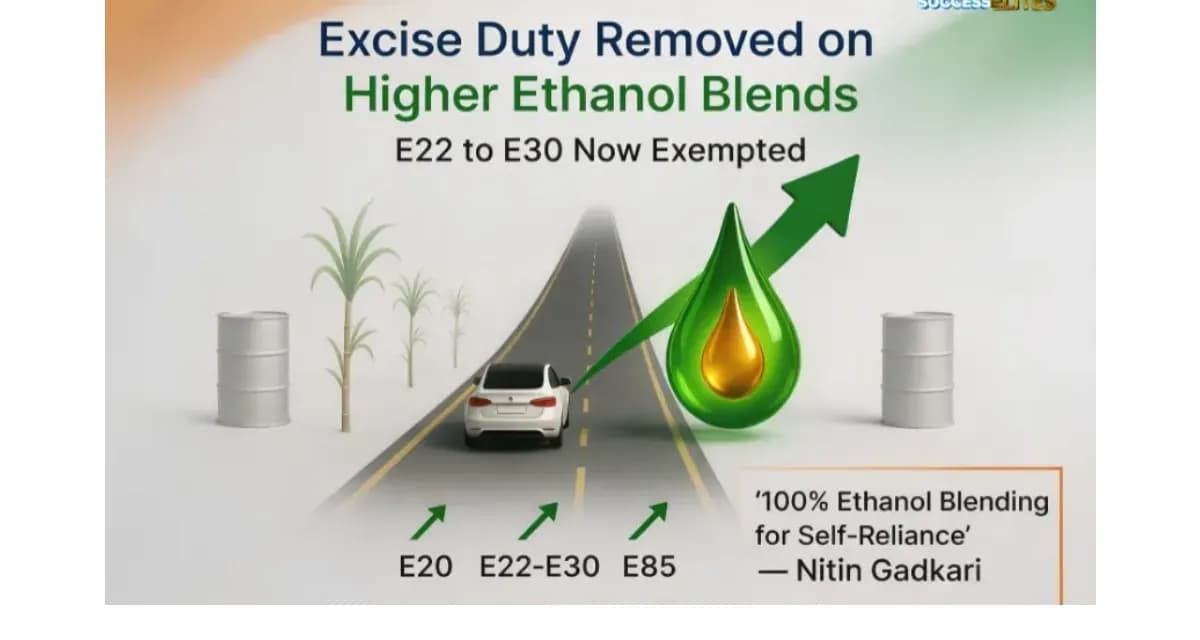
The Indian government has granted a central excise duty exemption to four higher ethanol-petrol blends, E22, E25, E27, and E30, none of which are currently available at fuel stations.
The move is expected to make these blends commercially viable for oil marketing companies, with the potential to be priced lower than E20.
India has taken another step forward in its ethanol blending roadmap. The government has announced a central excise duty exemption on petrol blended with ethanol concentrations of 22, 25, 27, and 30 percent, known as E22, E25, E27, and E30, respectively.
While none of these fuels are currently available at retail pumps, the fiscal relief is designed to pave the way for their commercial viability once the supply chain is in place.
The Bureau of Indian Standards had already established fuel standards for these blends on May 19, 2026, so the regulatory framework is steadily taking shape. With the excise exemption now in place, these higher-blend fuels could eventually be priced lower than E20 petrol, which stood at Rs 102.12 per litre in Delhi as of June 11, 2026. That is a meaningful proposition for both oil marketing companies and everyday motorists.
The Bureau of Indian Standards described the intent behind the move plainly. Following the achievement of 20 percent ethanol blending under the Ethanol Blended Petrol programme, the new standard aims to promote cleaner transportation, enhance energy security, reduce crude oil imports, and support the agriculture sector.
In other words, this is not just about cheaper fuel; it is part of a wider national ambition to reduce dependence on imported crude.
E85 Already on Sale as India Accelerates Ethanol Push
500 E85 Stations Targeted Across India by Year-End
The duty exemption on mid-range blends comes just days after a more dramatic development on the ethanol front. On June 5, 2026, the government introduced E85 fuel, a blend of 85 percent ethanol and petrol, priced at Rs 82.12 per litre, which is Rs 20 lower than E20. That gap in pricing is hard to ignore.
In the near term, the government plans to establish around 50 to 100 E85 fuel stations across the Delhi-NCR and Mumbai-Pune-Nagpur corridors, with a target of reaching 500 stations by the end of 2026.
E85 Vehicles Need More Than a Fuel Switch
One thing worth noting is that using E85 is not as simple as pulling up to a different pump. Vehicles compatible with E85 require additional engineering and validation work around engine calibration, fuel-system durability, corrosion resistance, and material compatibility; standard E20-tuned cars cannot simply run on it.
Maruti Suzuki showcased the production-spec Wagon R Flex Fuel on June 4, 2026, having previously displayed prototypes on two separate occasions. For now, the model is available only for commercial use, and its price has not been announced.
Isobutanol Being Explored for Diesel Blending
Beyond petrol, the government is also exploring the blending of isobutanol, a biofuel derived from ethanol, with diesel. This shift follows unsuccessful trials of direct ethanol-diesel blending. It signals that India's biofuel ambitions extend well beyond the petrol engine.
Also read: