Driving Licence (DL) in India: Types, Eligibility & How to Apply

Explore Everything About Your Vehicle





What is Driving License (DL)?
Driving a vehicle is a responsibility, and to ensure the safety of everyone on the road, only individuals who have learned to drive are permitted to do so. To confirm that a vehicle is in capable hands, a Driving Licence is issued.
In India, every driver is required to carry this essential document, as it certifies that the individual is competent to drive. There are many important aspects related to a driving licence, and we are here to guide you with detailed and reliable information.
A Driving License (D.L.) is an official document issued by a state in the form of a government permit card. Chapter II (Section 3 - 28) of the Motor Vehicles Act, 1988 mandates the possession of a driver's licence to operate a motor vehicle on Indian public highways.
Two-wheelers, four-wheelers, and other types of vehicles are included in this category. No one can drive in a public area without a driving licence issued by the Regional Transport Office (RTO) or Regional Transport Authority (RTA), according to this Act.
What is the significance of a Driving Licence in India?
Driving Licence, commonly called ‘D.L.’, is a government-issued document that holds great significance. A Driving Licence specifies that the licence holder is aware of the traffic laws and regulations defined under the Motor Vehicles Act, 1988.
The licence is issued to the individual only if he qualifies for a driving test conducted by the Regional Transport Office (RTO) or Regional Transport Authority (RTA) and is examined by the District Transport Officer (DTO) or Motor Vehicle Inspector (MVI).
An individual without a valid D.L. cannot drive a vehicle and if caught, is liable for punishment under the law.
What are the key features of a Driving Licence?
The key specifications of a D.L. are:
- Legal requirement: To drive a vehicle on Indian roads, an individual must have a D.L. as mentioned under the MVA, 1988.
- Identity proof: A DL often acts as an identity proof as it is issued by the Government of India.
- Validity: A permanent DL in India has a validity of up to 20 years or till 50 years of age. The licence holder can drive the vehicle across the country. The validity varied depending on the licence type.
- Vehicle class: The licence shows the vehicle class to which it belongs.
- Unique Identification Number: The licence carries a non-transferable UID (Unique Identification Number).
What are the different types of a Driving Licence?
There are different types of D.L. depending on the driving purpose and the type of vehicle. RTO in India issues four types of driving licences:
Learner’s Licence
In India, you will be awarded a learning licence before receiving a permanent driver's licence. This licence allows you to ride in vehicles for learning or to improve your driving skills before taking a test for a permanent driving licence.
- Validity: 6 months.
Permanent Licence
The RTO will grant you a permanent driving licence if you pass a driving test. A permanent driving licence can be applied online by any Indian citizen who is 18 years old or more. This document is required to operate personal vehicles such as cars and motorcycles.
- Validity: Up to 20 years or till 50 years of age.
Commercial Driving Licence
A commercial driver's licence is required to operate large/heavy vehicles such as buses or trucks. These vehicles can be either passenger or cargo vehicles. The eligibility requirements for this type of licence differ from those of a permanent driver's licence. To apply for a commercial driver's licence, the applicant must have completed the eighth grade.
- Validity: Up to 3 years from the date of issuance.
International Driving Permit
An international driving permit is required for anyone who desires to drive a vehicle outside India, as the name implies. You'll have to reapply for your international driving permit after it expires.
- Validity: Up to 1 year from the date of issuance.
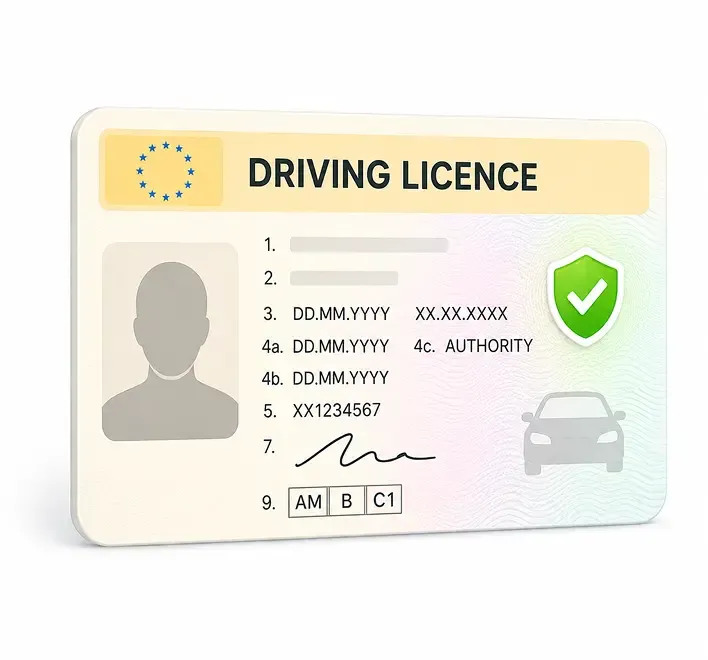
Driving Licence category and class based on the vehicle class
| Licence Type | Licence Class | Vehicle Type/Description |
|---|---|---|
| Permanent Licence | MC 50CC (Motorcycle 50cc) | Motorcycles having an 50 cc or less engine capacity |
| Permanent Licence | MCWOG/FVG | Motorcycles without gears, with any engine capacity |
| Permanent Licence | LMV-NT | Light motor vehicles used for non-transport purposes |
| Permanent Licence | MC EX50CC | Motorcycles with gear Motorcycles with 50 cc or more engine capacity Light Motor Vehicles (LMVs), including cars |
| Permanent Licence | MC With Gear or M/CYCL.WG | All motorcycles (including the gear ones also) |
| Commercial Licence | MGV | Medium Goods Vehicle |
| Commercial Licence | LMV | Light Motor Vehicle - jeep, taxis, motorcars, etc. |
| Commercial Licence | HMV | Heavy Goods Vehicle |
| Commercial Licence | HGMV | Heavy Goods Motor Vehicle |
| Commercial Licence | HPMV/HTV | Heavy Passenger Motor Vehicle/Heavy Transport Vehicle |
What is the eligibility for having a Driving Licence?
When it comes to obtaining a driver's licence, the Motor Vehicles Act of 1988 contains specific eligibility standards. The eligibility criteria vary depending on the vehicle type and, as a result, on the type of licence.
The eligibility criteria for getting a driving licence include the following:
- Age
- Medical fitness
- Learner’s licence requirement
Age
Age plays a vital role in defining the eligibility for a Driving Licence. To drive a vehicle on Indian roads, one should meet the specified age requirements.
The table below contains more information regarding the age limit for obtaining a driver's licence.
| Vehicle Type | Eligibility Criteria |
|---|---|
| Motorcycle without gear (upto 50 ccs) | 16 years of age + parental consent |
| Four-wheeler vehicles/Motorcycle with gear | 18 years of age + knowledge of traffic rules and regulations |
| Heavy commercial vehicles | <18 years of age (in some states 20) + formal education to up to 8th standard + driving training from a government - affiliated centre |
Medical evaluation
To get a DL, one should be physically and mentally sound. To analyse this, a medical evaluation is conducted to examine the vision, hearing, epileps or any other physical or mental deformity/disability.
Learner’s licence requirement
Before getting a permanent licence, one needs to have a ‘Learner’s Licence’. Without this licence, one cannot apply to get a permanent D.L.
Under what cases is a Driving Licence application disqualified?
There are some cases under which the application to get a Driving Licence gets rejected or disqualified.
The most common reasons under which a DL is not issued include:
- Medical impairment
- Neurological problem
- Uncontrolled seizures
- Epilepsy
- Any physical disability
- A person disqualified from the court
- Having a criminal record
How to apply for a permanent Driving Licence online?
A Driving Licence can be applied online through Parivahan.
Steps to Apply for a Permanent DL
Step 1. Navigate to the official website of Parivahan Sewa.
Step 2. Go to the ‘Online Services’ and click on ‘Driving Licence Related Services’.
Step 3. Select the state and click on ‘Apply for Driving Licence’.
Step 4. Click on ‘Continue’ and fill out the application form.
Step 5. Upload the clear copies of documents.
Step 6. Book a slot for the driving test and pay the fees
Step 7. Visit the location on the date and time opted for driving test.
Step 8. The Driving Licence will then be delivered to the registered address if the test is qualified.
What documents are required for a Driving Licence application?
Documents are required for a Driving Licence application:
- Age proof: To verify the age of the applicant. The age proofs include - 10th marksheet, birth certificate, passport, etc.
- Identity proof: To verify the identity of the applicant. The proofs could be - Aadhar card, PAN, voter ID or passport.
- Address proof: To confirm the applicant’s residence or address. Documents to be submitted can include either of the documents - Passport, utility bills, rental agreement, etc.
- DL application form: A duly filled application form on the Parivahan (online) or at the RTO (offline).
- Learner’s licence: Applicant should have a learner’s licence to get a permanent DL.
- Medical certificate: A medical certificate stating that the applicant is sound, physically and mentally.
- Passport-sized photograph: A recently clicked coloured passport-sized photograph of the applicant.
- Payment receipt: A clear copy of the fee receipt for the application.
What details does a Driving Licence carry?
A Driving Licence carries key personal and legal details that identify the driver and specify their driving rights. The details on a licence confirm the holder’s identity and legal authorization to drive a vehicle on Indian roads.
The key information a licence have are:
- Name of the licence holder
- Photograph and signature
- Date of birth
- Driving Licence number/UID (Unique Identification Number)
- Issuing authority (RTO/RTA)
- Date of issue and validity period
- Blood group
- Vehicle class permitted to drive
- Address of the licence holder
How to check the status of the Driving Licence application online?
After submitting the application for getting a Driving Licence, the applicants can track the status of the application to stay updated. Applicants can either visit the concerned RTO along with the application details to know the status offline or can track the status online.
Steps to know the status of the DL online:
Step 1. Visit the official website of Parivahan Sewa.
Step 2. Go to ‘Online Services’ and click on ‘Driving Licence Related Services’.
Step 3. Choose the state and click on ‘Application Status’.
Step 4. Provide the asked details - application number, date of birth, etc.
Step 5. Fill in the displayed captcha accurately.
Step 6. Click on ‘Submit’ to know the status of your application.
Driving Licence fees in India
There are certain fees associated with the Driving Licence. The fees vary depending on the type of licence and often by the states.
Driving Licence Fees
| Description | Amount (INR) |
|---|---|
| Learner’s licence test fee or repeat test fee (as the case may be) | 50 |
| For test, or repeat test, as the case may be, of competence to drive (for each class of vehicle) | 300 |
| Issue of learner’s licence in Form 3 for each class of vehicle | 150 |
| Issue of a driving licence | 200 |
| Issue of an International Driving Permit | 1000 |
| Addition of another class of vehicle to the driving licence | 500 |
| Renewal of driving licence | 200 |
| Renewal of a driving licence for which an application is made after the grace period | 300.00/- (Additional fee at the rate of Rupees One Thousand Only for delay of each year or part thereof, reckoned from the date of expiry of the grace period, shall be levied. |
| Issue or renewal of a licence to a school or establishment for imparting instructions in driving | 10,000 |
| Issue of duplicate licence to a school or establishment for imparting instructions in driving | 5,000 |
| An appeal against the orders of the licensing authority referred to in rule 29 | 500 |
| Any application for a change in address or any other particulars recorded in the driving licence, e.g., address, etc. | 200 |
| Endorsement or renewal of authorisation for vehicle carrying hazardous goods | 1,000 |
Penalty for not having a valid Driving Licence
The penalty for driving a vehicle without a valid licence in India differs from states. As per Section 3 of the Motor Vehicles Act, 1988, an individual, if caught driving without a DL, has to undergo the punishment as defined under the law.
Common Driving Licence Offences
| Offence | First time |
|---|---|
| Driving w/o a valid licence | ₹5,000/3 months of imprisonment or both |
| Allowing someone w/o a valid licence to drive | ₹5,000/3 months of imprisonment or both |
| Minor driving a vehicle | ₹25,000/3 years of imprisonment + cancellation of vehicle registration for a year |
New Rules: Driving Licence 2026
There are some updates in the rules of DL, a driver should know to ensure compliance with the amendments and promote safe driving.
- As per the updated law, giving a driving test at the RTO is not compulsory. The applicants can go through the driving test at an ‘Accredited Private School’.
- As of May 2025, the virtual or soft copy of DL is compliant with the MVA, 1988 and is accepted by the traffic police officers.
- 5 or more challans in a year will result in the disqualification of the licence.
- Learner’s Licence holders have to complete mandatory training before attempting for a driving test.
How to renew a Driving Licence online?
Similar to the permanent Driving Licence application, the renewal request can be raised online through Parivahan Sewa.
Steps to Renew a Driving Licence
Step 1. Go to the official website of Parivahan Sewa.
Step 2. Select ‘Driving Licence Related Services’ from the ‘Online Services’ dropdown.
Step 3. Choose a state from the drop down.
Step 4. Click on ‘Apply for DL Renewal’.
Step 5. Fill the required forms and upload the documents.
Step 6. Upload a clear passport-size photograph and signature (if required).
Step 7. Book a preferred time slot for the driving test (only for the Additional Endorsement of Driving Licence).
Step 8. Pay the Driving Licence renewal fees and get the receipt.
When to renew a Driving Licence in India?
The application for renewal of a DL should be submitted at least 1 month before the expiry of the Driving Licence.
Other Driving Licence Renewal Cases
| Case | Consequence |
|---|---|
| If applied after 5 years or more after the expiry of the licence | Some formalities are to be performed. |
| If a renewal request is made earlier or within 30 days of the licence expiry | Licence renewal will be made with effect from the date of expiry. |
| If the request is raised after or more than 30 days of the licence expiry | Licence renewal will be made with effect from the date of the application received + ₹30 fee will be imposed. |
Documents required for Driving Licence renewal
To renew a Driving Licence, the applicant has to provide the following documents:
Driving Licence
Form 2
Form 1A (Medical Certificate for Transport Vehicles only) or Form No. 1 (Self-declaration as to the physical fitness for Non-Transport Vehicles)
Renewal fees and user charges
How and when to get a duplicate Driving Licence?
A duplicate Driving License is issued on request of the individual if the original licence is lost, stolen, damaged, torn, modification in personal details is required, such as address update, etc.
Who can apply for a duplicate Driving Licence?
The following can apply for the duplicate licence:
Individuals who lost the original licence.
Whose licence is damaged/lost or stolen.
Who wants to change the details on the licence, say, address.
Whose licence has expired and renewal is in process
Individuals who have relocated and have to get the licence update as per the new jurisdiction.
What is the process to apply for a duplicate Driving Licence?
The process to apply for a duplicate Driving Licence is simple and can be done easily through the Parivahan Sewa portal.
Steps to Apply for a Duplicate Driving Licence
Step 1. Go to the Parivahan Sewa portal.
Step 2. From the ‘Online Services’ drop-down, select ‘ Driving Related Services’.
Step 3. Select the state and click on ‘Apply for Duplicate DL’.
Step 4. Fill in the application form and upload the required documents or photograph.
Step 5. Pay the renewal fee and get the payment receipt.
Documents required for the duplicate licence renwal application
- Form LLD
- Form No. 1
- FIR (in case it is stolen or missed)
- Original DL (if damaged)
- Attested copy of original DL (if stolen or lost)
- Challan clearance report from the traffic police (for transport vehicle)
- Recent passport-sized photograph
- A copy of a valid address proof (self-attested)
How to download a Driving Licence?
A DL can be downloaded easily online through multiple platforms. The highly reliable and convenient platforms to get a DL are:
Sarathi Parivahan
DigiLocker
mParivahan
Sarathi Parivahan
Managed by MoRTH, Sarathi Parivahan gives a simple interface, allowing individuals to download the DL.
Steps to Download a Driving Licence through Sarathi Parivahan
Step 1. Go to the Sarathi Parivahan portal.
Step 2. Select ‘Driving Licence Related Services’ from the ‘Online Services’ header.
Step 3. Choose the state and select ‘Print Driving Licence’ from the ‘Driving Licence’ drop-down.
Step 4. Provide the ‘DL/Application Number’ and ‘Date of Birth’ in the box.
Step 5. Click on ‘Print DL’ to download the licence.
Through DigiLocker
Backed by MeitY (Ministry of Electronics and Information Technology), DigiLocker is a reliable and simple platform to download a Driving Licence.
Steps to Download a Driving Licence through DigiLocker
Step 1. Visit the DigiLocker website.
Step 2. Log in using the mobile number linked to the Aadhar card or complete the registration.
Step 3. Enter the six-digit PIN to access the services.
Step 4. Complete the verification by entering the OTP sent to the registered mobile number.
Step 5. Click on ‘Search Documents’ listed on the left-side panel.
Step 6. Click on Driving Licence – Ministry of Road Transport and Highways.
Step 7. Enter your DL number and click on ‘Get Document’ to download the licence.
Through mParivahan app
mParivahan app offers handy access to the vehicle-related services. Developed by MoRTH, this app allows users to download the DL.
Steps to Download a Driving Licence through mParivahan app
Step 1. Get the mParivahan app on the mobile device.
Step 2. Create an account or log in using the registered mobile number.
Step 3. Complete the verification by entering the OTP.
Step 4. Click on ‘Driving Licence’ from the home page.
Step 5. Enter your DL number and date of birth to proceed.
Step 6. Click ‘Add My Driving Licence’ and check the same.
Step 7. Download the virtual licence.
The soft copy of DL is legally valid across the country as per the MoRTH guidelines. This signifies that the licence is acceptable by the traffic police officer and is legit in official proceedings as well.
How do traffic challans affect a Driving Licence?
An e-Challan is a traffic violation ticket issued if the driver is found guilty of not following the traffic rules and regulations. Not having a valid DL is punishable under the MVA, 1988. The traffic challan directly impacts the DL:
As per the updated rules, if an individual has 5 or more challans in a year, it might lead to the disqualification of the licence.
Moreover, depending on the seriousness and frequency (first or repeated) of the offence, the licence can even be cancelled or suspended, depending on the regulations of that particular state.
For instance, the Telangana e-challan system follows a 12-point penalty system.
Why check traffic challans in India?
Traffic challans or electronic challans (E-challan) are a ticket issued to the driver who fails to comply with the described road rules and regulations. Clearing the e-challan becomes important to ensure that no further penalties or fines are imposed and to avoid any legal proceedings/court hearings.
Failing to pay the e-challan will result in:
Increased penalties/fines
Suspension or cancellation of DL
Court summons
Thus, to ensure timely payment of the traffic fines, checking them becomes important.
You can check your e challan in your cities and states before applying for DL:
| Cities | States |
|---|---|
| Chennai E Challan | Tamil Nadu E Challan |
| Hyderabad E Challan | Telangana E Challan |
| Pune E Challan | Maharashtra E Challan |
| Bangalore E Challan | Karnataka E Challan |
| Mumbai E Challan | Haryana E Challan |
How to check and pay traffic challans in India on Park+?
Park+ allows individuals to check any challan issued against their vehicle in a simplified manner.
Steps to check and pay e-challan on Park+:
Step 1. Visit Park+ and go to the ‘E- Challan’ section.
Step 2. Enter the ‘Vehicle Number’ in the provided box.
Step 3. Click on ‘Check Challan’ to check if there is any outstanding challan.
Step 4. Review the challan details to ensure that they are correct.
Step 5. Pay the challan and get the receipt to avoid further penalties.
To make sure drivers pay the traffic challan within the stipulated time, Park+ sends notifications and alerts, helping them to avoid adverse consequences.
A Driving Licence (DL) is an important document and every driver should carry this when driving on Indian roads to avoid e-challans and ensure proper adherence to the traffic laws. In case the original licence is lost or damaged, apply for a duplicate licence. Inculcate the habit of applying for the licence renewal a month before the expiry date for smooth and timely processing of the application. Get Park+ today to check and pay challans timely for smooth driving.
Other car service on park+ : Valet Services, FASTag, Car Insurance, Car loan ,Vehicle Owner Details, New Cars
Check Driving License by States
DL Telangana
DL Bihar
DL Madhya Pradesh
DL West Bengal
DL Haryana
DL Jharkhand
DL Karnataka
DL Andhra Pradesh
DL Maharashtra
DL Punjab
DL Rajasthan
DL Sikkim
DL Uttar Pradesh
DL Gujarat
DL Kerala
DL Odisha
DL Tamil Nadu
DL Assam
DL Manipur
DL Uttarakhand
DL Nagaland
DL Chhattisgarh
DL Goa
DL Himachal Pradesh
DL Tripura
DL Mizoram
DL Meghalaya
Check Driving License by Cities
Driving License in Mumbai
Driving License in Hyderabad
Driving License in Pune
Driving License in Gurgaon
Driving License in Delhi
Driving License in Kanpur
Driving License in Chandigarh
Driving License in Kolkata
Driving License in Ahmedabad
Driving License in Ghaziabad
Driving License in Patna
Driving License in Noida
Driving License in Lucknow
Driving License in Jaipur
Driving License in Indore
Driving License in Ludhiana
Driving License in Faridabad
Driving License in Vadodara
Driving License in Nagpur