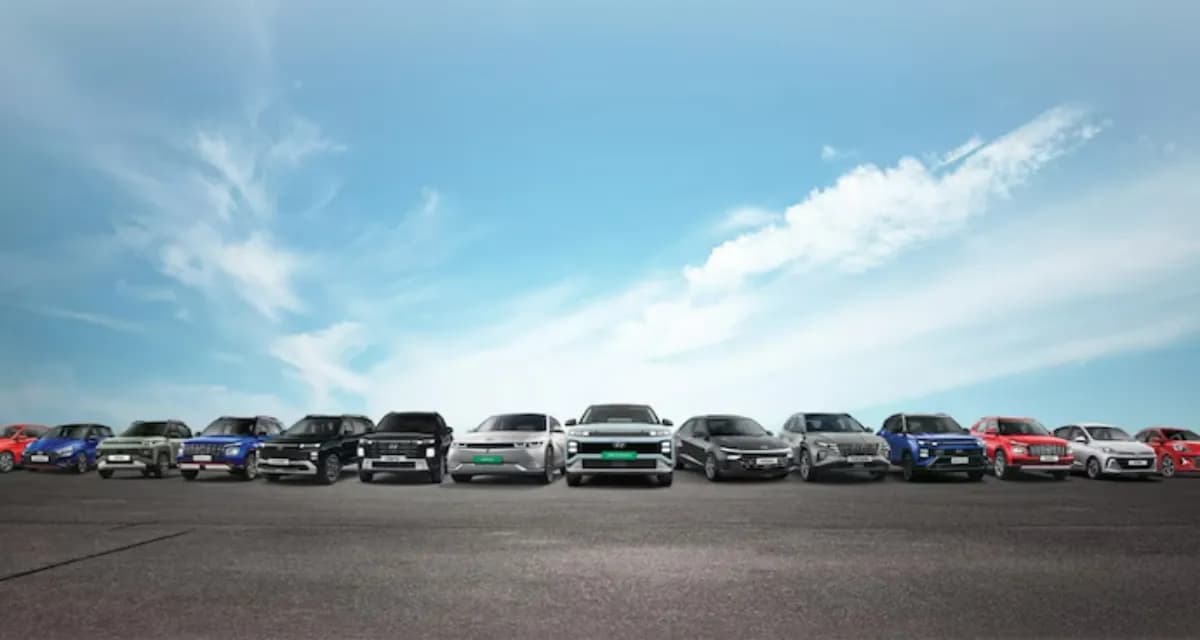
Innovation, quality, and consumer confidence are the three words that one can use to describe the path of Hyundai, which completed 30 glorious years in India-from the legendary Santro to the future-driven IONIQ 5. It is a landmark moment that informs us about the phenomenal ability of the South Korean automaker to transform according to the changing auto landscape in India, but stay true to its commitment to delivering cars that Indians love.
Hyundai Motor India Limited (HMIL), thus, in strengthening its position as India's best foreign car producer, has become a member of the exclusive 90 lakh (9 million) cumulative sales club here. The milestone comes just as the country is celebrating the 30-year milestone since it was introduced to the Indian auto market in the year 1996, hence marking Hyundai's successful streak in understanding and satisfying the diverse demands of Indian buyers.
A Three-Decade Journey
Hyundai's Indian sojourn began with the launch of the humble Santro in 1998, a car that revolutionized the small car segment with its tall-boy design and rugged performance. What began as a modest operation is now a manufacturing giant with an annual production capacity of over 850,000 units in its state-of-the-art facilities in Chennai.
In the early years of its existence, the company focused exclusively on building its presence in the Indian automobile industry, where Santro overnight became a household name. By the mid-2000s, the first million cars had already been sold in India, giving a strong foundation to the later fast growth of the company.
Portfolio Evolution
Hyundai's product strategy has been the fulcrum upon which this masterful feat was achieved. Its car lineup was changed from one that was focused narrowly on small cars to a broad one covering different segments.
Some of them are:
Hatchbacks: From the Santro, its hatchback lineup expanded to include the i10, Grand i10, i20, and, more recently, the i20 N Line.
Sedans: From Accent through the Verna to the Aura.
SUVs: The sub-segment that powered Hyundai's growth was defined by the launch of the Creta, Venue, Tucson, and Alcazar.
Electric Vehicles: It is the Kona Electric and its new premium IONIQ 5 that are setting the pace. The manufacturing of the Creta in 2015 was special, being a consistent best-selling SUV in India and playing a major role in the milestone: this sub-four-meter SUV revolutionized its segment with more than 9 lakh units sold alone.
Made in India, for the World
One of the major success drivers for Hyundai has been its 'Made in India' strategy. The Chennai plant serves local demand but also ships the car to over 88 countries in Africa, the Middle East, Latin America, Australia, and Asia. Hyundai has shipped over 3.5 million cars from India, thus making India a significant global production hub.
Technology and Innovation Leadership
Hyundai has realized the introduction of many innovations ahead of the competition in the Indian market. Ventilated seats, panoramic sunroof, connected car technology (BlueLink), and advanced driver assistance systems were pioneered by Hyundai in various segments, delivering world-class automobile experiences at affordable prices to Indian consumers.
Challenges and Adaptations
The journey to reaching 90 lakh sales has also been tough in its way. Hyundai has navigated many challenges of recession, changes in emission norms, the COVID-19 pandemic, and a lack of semiconductor supplies very well. These were addressed and adapted by the company in a relatively nimble manner, along with the product development and launch cycles.
During pandemic years, Hyundai quickly transitioned to digital sales channels and contactless services that allowed it to keep running while ensuring customer safety.
Future Roadmap
As Hyundai celebrated, it has already mapped out its future road map for the Indian market.
Electric Mobility: Getting ready to launch a range of affordable EVs suitable for Indian conditions.
Increased Manufacturing: Expansion of manufacturing capacity to cater to incremental needs.
Connected Mobility: Upgradation of connected car technologies and digital services.
Localization: Improve component localization so they stay price-competitive.
Conclusion
With the realization of its 90 lakh sales in 30 years, Hyundai's product strategy is vindicated, but silently, it is the near-emotional bonding that the company has created with Indian consumers. Hyundai's success story binds itself from being viewed as a foreign newcomer to one that is now part and parcel of every Indian family's own motorized excursions, intertwined with the story of India's own economic growth and changing consumer sentiments.
As the industry looks towards both digitalization and electrification, the platform seems primed for Hyundai to continue growing and even hopefully hit 1 crore sales within record time. So, 90 lakh is, at least for the time being, far from anything but a celebration in one of the globe's most competitive automobile markets as evidence of Hyundai's commitment to an appreciation of and responsiveness to Indian buyers.
Also Read: