PUC Certificate Karnataka: Check PUC Expiry Date by Vehicle Number Online


Explore Everything About Your Vehicle





What does a PUC Certificate mean in Karnataka?
A Pollution Under Control Certificate (PUCC) is a government-issued document stating that the emissions released by your vehicle are within the limit specified under the applicable law. According to the Motor Vehicles Act, 1988, every vehicle (except EVs) in the country is required by law to have this document to avoid penalties and ensure proper adherence to the law.
What details does a PUCC carry?
A Pollution Under Control Certificate in Karnataka carries the following key details: Vehicle details: The details of the vehicle, such as make, model, vehicle registration number, etc.
- Unique number: A ‘Unique Certification Number’ for easy tracking and verification.
- Testing details: The date and time of the vehicle emission testing.
- Emission reading: The detailed emission reading.
- Validity: The validity of the PUC Certificate.
- Status of the test: The compliance status of the test - fail or pass.
- Details of authorized center: The address, name and other details of the authorised center.
- Technical information: Vehicle emission norms compliance.
- Vehicle’s owner information: The basic details of the vehicle owner (masked) for transparency.
Note: In case a vehicle fails to pass the emission test, a rejection slip is issued instead of a PUCC. The vehicle has to go for a re-test within the mentioned timeline.
Why is the Pollution Under Control Certificate important?
PUCC holds a significant place and below are the prime reasons clarifying its importance:
- Mandatory by law: PUCC is an important document that every vehicle owner should have as per the Motor Vehicles Act, 1988 and the Central Motor Vehicles Rule, 1989.
- Environmental benefit: A valid PUCC states that the vehicle does not cross the permissible emissions or pollution norms. Thus, this way it also helps in curbing pollution.
- Vehicle health: Getting the examination done after every 6 months (for old cars) helps the vehicle’s owner understand the pollution level and the health of the vehicle as well.
- Motor insurance renewal: PUCC is important when renewing a car insurance or motor insurance policy. Not having a valid pollution certificate will create a problem.
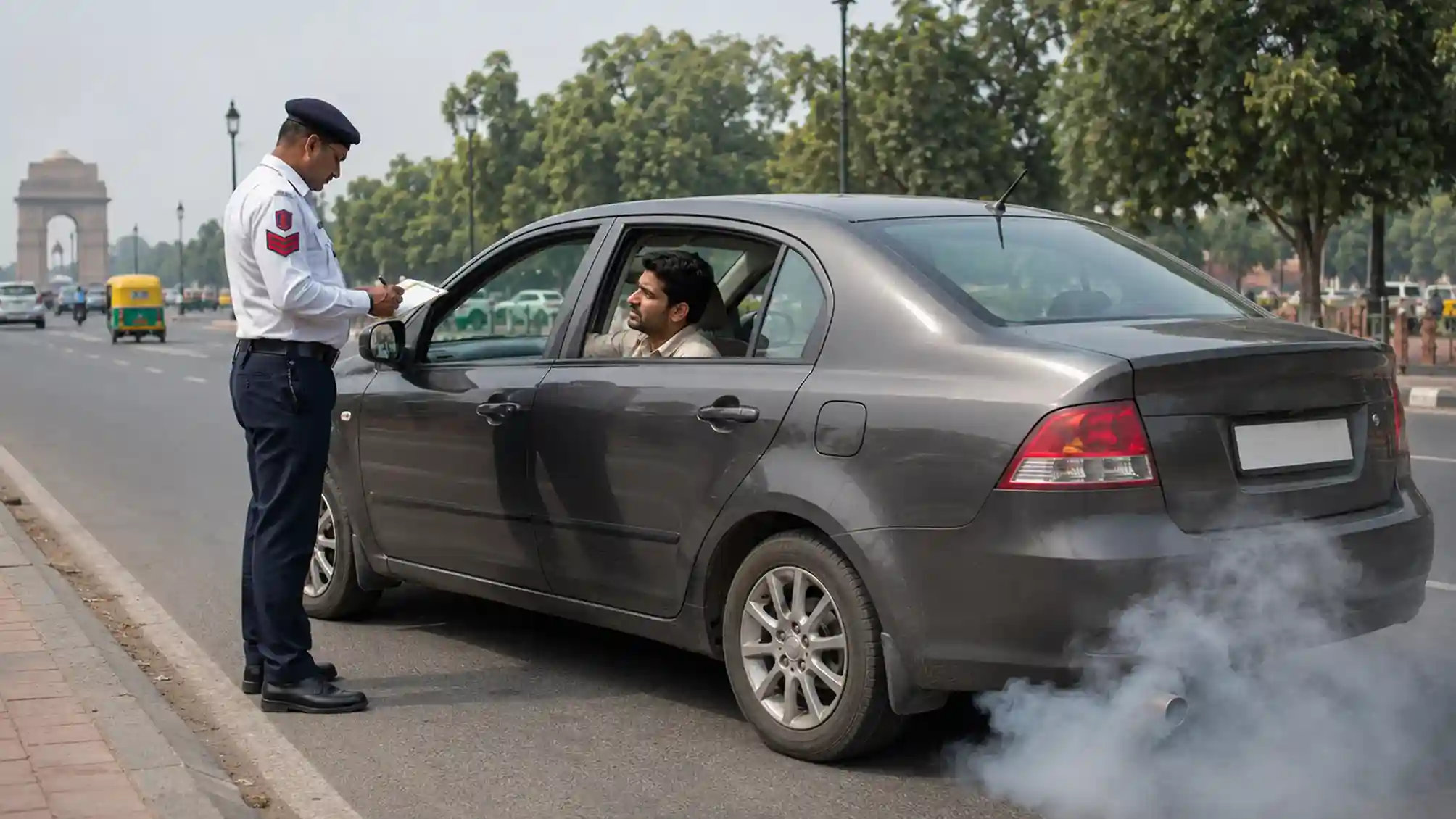
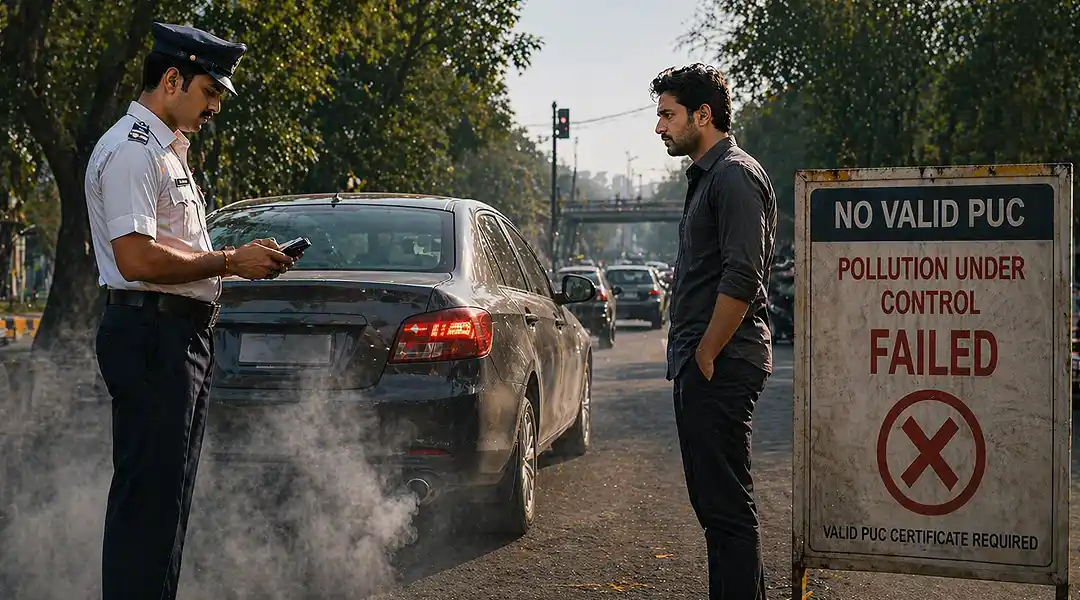
- Avoid eChallan: Not having a valid Pollution Under Control certificate attracts fines or challan penalty in Delhi. Thus, it is advised to carry a PUCC when driving a vehicle.
Laws relating to the PUC Certificate in India
The Pollution Under Control Certificate (PUCC) is a mandatory document under the Motor Vehicles Act, 1988 and it works as per the regulations, limits and rules determined under the Central Motor Vehicles Act, 1989.
However, in addition to this, there are several other laws as well that play a vital role in PUCC and they are:
- Section 110 of the Motor Vehicles Act, 1988: Empowers the Central Government to make rules regulating the construction, equipment, and maintenance of motor vehicles and trailers.
- Section 190(2) of the Motor Vehicles Act, 1988: Fines and penalties for not having a PUCC.
- Rule 115 of the Central Motor Vehicles Rules, 1989: Defines the limits of the vehicle emissions for the vehicles.
- Rule 115(7) of the Central Motor Vehicles Rules, 1989: Mandates all new vehicles to have a valid PUCC issued by an agency authorised by the State Government, after a year from the date of registration.
- Rule 116 of the Central Motor Vehicles Rules, 1989: Grants traffic officers the power to demand a PUCC. Further, it also empowers them to demand a re-test of the vehicles within 7 days, in case they believe the vehicle is not adhering to the vehicle emissions limits.
- Rule 116(1) of the Central Motor Vehicles Rules, 1989: The validity of the PUCC.
- Standardized Format (G.S.R. 410(E) - 2021): The Ministry of Road and Transport Highways defined a standardized format for the Pollution Under Control form, aiming for ‘One Nation, One PUC’.
- G.S.R. 527(E): Linkage of PUC data with VAHAN database.
How to get a Pollution Under Control Certificate in Karnataka?
To get a PUCC in Karnataka, the vehicle has to undergo an emission test at the specified centers. Once the pollution emission test is completed, the vehicle owner can get the certificate either online or offline.
How to get a PUC Certificate online in Karnataka?
Parivahan offers a simple and secure interface for individuals to get a PUCC online.
Here are the simple steps to follow:
- Visit the VAHAN Parivahan website.
- Click on ‘PUC Certificate’.
- Enter the ‘Registration Number’ and ‘Chassis Number’ (last 5 digits).
- Enter the displayed security code for verification.
- Click on ‘PUC Details’ and download the pollution certificate.
How to get a PUCC offline in Karnataka?
Here are the simple steps to get the PUCC offline in Karnataka:
- Visit any of the authorised emission testing centers in Karnataka for the vehicle’s examination.
- Position the vehicle as per the instructions provided by the test operator/concerned person.
- The operator will start the test by inserting the pipe to get clear readings.
- The test operator will then note down the emission readings.
- Pay the applicable charges to the operator.
- A PUCC or rejection slip will be issued to the vehicle owner, based on the readings.
Where can a vehicle emission test be performed in Karnataka?
For examination of the vehicle, the drivers can visit the following locations:
- Petrol pumps: Some petrol pumps offer the facility of pollution emission testing in Karnataka.
- Authorised garages: At the RTO-approved garages.
How to find the nearest authorised emission test centres in Karnataka?
Park+ is a simple online platform offering vehicle owners the facility to check the authorised PUCC centres in Karnataka. To check the nearest pollution testing centres in Karnataka, perform the following steps:
- Go to the Park+ mobile app.
- Search for PUCC centres.
- Enter the location and state, say Karnataka.
- Get the complete list of the authorised PUCC centres.
Types of pollution emission tests in Karnataka
Based on the fuel type, the emission test differs. Below are the different tests conducted for the vehicles:
| Fuel Type | Test | Description |
|---|---|---|
| Petrol | Carbon Dioxide (CO2) | To examine CO2 levels. |
| Hydrocarbon | To determine the level of unburnt fuel. | |
| Carbon Monoxide (CO) | To assess air intake and fuel combustion efficiency. | |
| Diesel | Idling Carbon Monoxide (CO) | To determine the emissions of the vehicle parked with the engine on. |
| Smoke Density | To measure black smoke output for understanding the engine condition and fuel combustion. | |
| LPG/CNG | Carbon Monoxide (CO) | To understand fuel combustion efficiency and air intake. |
| Hydrocarbon | For knowing the fuel combustion level of the vehicle. | |
| System Soundness | To check if there are any leakages in the CNG/LPG system. |
How to renew a PUC Certificate in Karnataka?
PUCC renewal is an important process and should not be neglected at all. New vehicles, after a year of registration and old vehicles, after 6 months, are required to get the pollution certificate renewed without any delay.
For PUCC renewal in Karnataka, the vehicle owners need to get the vehicle emission test done. To do so, take the following steps:
- Check for the nearest pollution emission test center in Karnataka on Park+.
- Visit the centre and connect with the test operator.
- Follow the instructions of the test operator to get the emission test done.
- Pay the applicable test fees and wait for the results.
- Get the test results and the renewed PUCC.
Pro tips: - Check if the pollution certificate has a QR. - Ensure all the details are clearly printed on the certificate, such as validity, PUC serial number, emission readings, etc. - You can also download the PUCC certificate online from Parivahan.
What are the validity and renewal rules for the PUC Certificate in Karnataka?
The PUC Certificate in Karnataka needs to be renewed after the completion of its validity. The validity varies depending on the age of the vehicle - new cars, old cars and the test readings as well.
The validity and renewal rule might vary depending on the state; however, the standardised format defines the following:
| Case | Validity |
|---|---|
| New Vehicles (BS-VI compliant) | For 1 year, after which they need to get a PUC Certificate. |
| Other Vehicle | After every 6 months. |
| If vehicle emissions are higher or closer to a permissible limit during a test | PUCC is issued for a shorter period - say, for 3 months. |
*The validity may vary depending on the state.
How can I check the PUC Certificate expiry by the number plate?
If you are not aware of the PUCC's validity, take action to check it instantly. The validity can be checked instantly through online or offline ways.
Below are the steps involved in each case to check the certificate’s validity:
Online Method
Through Parivahan
The PUC Certificate expiry by number plate can be done easily through the Parivahan portal. To check the validity, follow these steps:
- Visit the Parivahan website.
- Go to the ‘PUC Certificate’ page.
- Enter the vehicle registration number and chassis number (last 5 digits).
- Type the displayed security code for quick verification.
- Click on ‘Get Details’ to check the validity of the certificate.
Offline Method
Through Certificate
This is the simplest method of checking the validity date. For this, one should have a printed copy of the certificate. The vehicle owners can check the validity of the certificate by checking the certificate.
Vehicle emission standards
Under the Pollution Control Law, there are certain emission criteria that must be followed by the vehicle. Below are the permissible emission standards based on the fuel types for different vehicles:
For new cars
| Type of vehicle | Carbon Monoxide (in %) | Hydrocarbon (in PPM) |
|---|---|---|
| BS6 and BS4 four-wheelers (CNG/LPG) | 0.3 | 200 |
| BS6 and BS4 four-wheelers (Petrol) | 0.3 | 200 |
| λ (lambda) | 1±0.03 or declared by the manufacturer | 1±0.03 or declared by the manufacturer |
For new bikes
| Type of vehicle | Carbon Monoxide (in %) | Hydrocarbon (in PPM) |
|---|---|---|
| BS6 two-wheelers/three-wheelers (CNG/LPG) | 0.5 | 500 |
| BS6 two-wheelers/three-wheelers (Petrol) | 0.5 | 500 |
For diesel vehicles
| Type of test | Light Absorption Coefficient | Maximum Smoke Density in Hartridge Units |
|---|---|---|
| Free acceleration test of BS4 diesel vehicles (naturally aspirated and turbocharged engine) | 1.62 | 50 |
| Free acceleration test of pre-BS4 diesel vehicles (naturally aspirated and turbocharged engine) | 2.45 | 65 |
For old vehicles (cars, bikes and three-wheelers)
| Type of vehicle | Carbon Monoxide (in %) | Hydrocarbon (in PPM) |
|---|---|---|
| BS2 four-wheelers (Petrol) | 3 | 1,500 |
| BS3 four-wheelers (Petrol) | 0.5 | 750 |
| Two/four-stroke two/three-wheelers manufactured on or before March 31, 2000 | 4.5 | 9,000 |
| Two-stroke two/three-wheelers manufactured after March 31, 2000 | 3.5 | 6,000 |
| Four-stroke two/three-wheelers manufactured after March 31, 2000 | 3.5 | 4,500 |
*The permissible emission standard might vary depending on the state.
Which vehicles are exempt from PUCC in India?
Though PUCC is mandatory for all vehicles in India, there are some exceptions. The electric vehicles and new vehicles are generally exempt from having a PUCC.
Electric Vehicles (EVs): These vehicles produce zero tailpipe emissions and thus, these vehicles are not required to have a Pollution Under Control Certificate (PUCC). New vehicles: New vehicles do not need to have a PUCC until 1 year from the date of registration.
Smart tips to avoid the PUC Certificate fines in Karnataka
Some smart tips can prevent motorists from receiving heavy fines. A few of the must-follow tips in consideration of the PUC Certificate are:
- Set a reminder for at least two weeks before the expiry date to renew the certificate online.
- Always carry the PUCC when driving/riding a vehicle.
- Ensure all the details are clearly mentioned on the certificate to avoid confusion.
- Keep a digital copy of the certificate.
- Get the emission test done at authorised centres only.
- Get the renewal done on time to ensure a smoother process of car insurance renewal.
PUC Certificate in Karnataka is an important document that every vehicle owner should have, especially when driving or riding a vehicle. This document reflects the vehicle’s health, prevents Karnataka eChallan and helps vehicle owners enjoy a smooth car insurance renewal process. However, the process to get a PUCC renewal certificate is simple and every motorist should responsibly comply with the laws relating to it.

Check PUC Certificate by Cities
PUC Certificate Arasikere
PUC Certificate Bagalkot
PUC Certificate Bailhongal
PUC Certificate Ballari
PUC Certificate Banashankari
PUC Certificate bangalore
PUC Certificate Bangalore Rural
PUC Certificate Bangalore Urban
PUC Certificate Bantwal
PUC Certificate Belagavi
PUC Certificate Belgaum
PUC Certificate Bengaluru
PUC Certificate Bhalki
PUC Certificate Bidar
PUC Certificate Chamarajanagar
PUC Certificate Chamrajnagar
PUC Certificate Channapatna
PUC Certificate Chikkaballapur
PUC Certificate Chikkamagaluru
PUC Certificate Chikodi
PUC Certificate Chintamani
PUC Certificate Chitradurga
PUC Certificate Dakshina Kannada
PUC Certificate Dandeli
PUC Certificate Davanagere
PUC Certificate Devanahalli
PUC Certificate Dharwad
PUC Certificate Gadag
PUC Certificate Gokak
PUC Certificate Gulbarga
PUC Certificate Gundlupet
PUC Certificate Hassan
PUC Certificate Haveri
PUC Certificate Honavar
PUC Certificate Hospet
PUC Certificate Hubli
PUC Certificate Hunsur
PUC Certificate Jamkhandi
PUC Certificate Kalaburagi
PUC Certificate Karkala
PUC Certificate Karwar
PUC Certificate Kodagu
PUC Certificate Kolar
PUC Certificate Koppal
PUC Certificate Kota
PUC Certificate Lakshmeshwar
PUC Certificate Lingsugur
PUC Certificate Maddur
PUC Certificate Madhugiri
PUC Certificate Madikeri
PUC Certificate Magadi
PUC Certificate Mahalingpur
PUC Certificate Malavalli
PUC Certificate Malur
PUC Certificate Mandya
PUC Certificate Mangalore
PUC Certificate Mangaluru
PUC Certificate Manvi
PUC Certificate Marathahalli
PUC Certificate Mudalgi
PUC Certificate Mudbidri
PUC Certificate Muddebihal
PUC Certificate Mudhol
PUC Certificate Mulbagal
PUC Certificate Mundargi
PUC Certificate Mysuru
PUC Certificate Nagamangala
PUC Certificate Nanjangud
PUC Certificate Pavagada
PUC Certificate Puttur
PUC Certificate Rabkavi Banhatti
PUC Certificate Raichur
PUC Certificate Rajajinagar
PUC Certificate Ramanagar
PUC Certificate Ramanagaram
PUC Certificate Ramdurg
PUC Certificate Ranibennur
PUC Certificate Robertson Pet
PUC Certificate Ron
PUC Certificate Sadalgi
PUC Certificate Sagar
PUC Certificate Sakleshpur
PUC Certificate Sandur
PUC Certificate Sankeshwar
PUC Certificate Saundatti Yellamma
PUC Certificate Savanur
PUC Certificate Sedam
PUC Certificate Shahpur
PUC Certificate Shiggaon
PUC Certificate Shikapur
PUC Certificate Shimoga
PUC Certificate Shivamogga
PUC Certificate Shorapur
PUC Certificate Shrirangapattana
PUC Certificate Sidlaghatta
PUC Certificate Sindgi
PUC Certificate Sindhnur
PUC Certificate Sira
PUC Certificate Sirsi
PUC Certificate Siruguppa
PUC Certificate Srinivaspur
PUC Certificate Surathkal
PUC Certificate Talikota
PUC Certificate Tarikere
PUC Certificate Tekkalakota
PUC Certificate Terdal
PUC Certificate Tiptur
PUC Certificate Tumakuru
PUC Certificate Udupi
PUC Certificate Uttara Kannada
PUC Certificate Vijayanagara
PUC Certificate Vijayapura
PUC Certificate Wadi
PUC Certificate Yadgir
PUC Certificate Yelahanka
Check PUC Certificate by States
PUC Certificate Andaman and Nicobar Islands
PUC Certificate Andhra Pradesh
PUC Certificate Arunachal Pradesh
PUC Certificate Assam
PUC Certificate Bihar
PUC Certificate Chhattisgarh
PUC Certificate Dadra and Nagar Haveli
PUC Certificate Delhi
PUC Certificate Goa
PUC Certificate Gujarat
PUC Certificate Haryana
PUC Certificate Himachal Pradesh
PUC Certificate Jammu and Kashmir
PUC Certificate Jharkhand
PUC Certificate Kerala
PUC Certificate Ladakh
PUC Certificate Lakshadweep
PUC Certificate Madhya Pradesh
PUC Certificate Maharashtra
PUC Certificate Manipur
PUC Certificate Meghalaya
PUC Certificate Mizoram
PUC Certificate Nagaland
PUC Certificate Odisha
PUC Certificate Puducherry
PUC Certificate Punjab
PUC Certificate Rajasthan
PUC Certificate Sikkim
PUC Certificate Tamil Nadu
PUC Certificate Telangana
PUC Certificate Tripura
PUC Certificate Uttar Pradesh
PUC Certificate Uttarakhand
PUC Certificate West Bengal
Check Petrol Prices State-Wise
Petrol Price in Andaman Nicobar
Petrol Price in Andhra Pradesh
Petrol Price in Arunachal Pradesh
Petrol Price in Assam
Petrol Price in Bihar
Petrol Price in Chandigarh
Petrol Price in Chhatisgarh
Petrol Price in Dadra Nagarhaveli
Petrol Price in Daman & Diu
Petrol Price in Delhi
Petrol Price in Goa
Petrol Price in Gujarat
Petrol Price in Haryana
Petrol Price in Himachal Pradesh
Petrol Price in Jammu & Kashmir
Petrol Price in Jharkhand
Petrol Price in Karnataka
Petrol Price in Kerala
Petrol Price in Madhya Pradesh
Petrol Price in Maharashtra
Petrol Price in Manipur
Petrol Price in Meghalaya
Petrol Price in Mizoram
Petrol Price in Nagaland
Petrol Price in Odisha
Petrol Price in Pondicherry
Petrol Price in Punjab
Petrol Price in Rajasthan
Petrol Price in Sikkim
Petrol Price in Tamil Nadu
Petrol Price in Telangana
Petrol Price in Tripura
Petrol Price in Uttar Pradesh
Petrol Price in Uttarakhand
Petrol Price in West Bengal
Check Diesel Prices State-Wise
Diesel Price in Andaman Nicobar
Diesel Price in Andhra Pradesh
Diesel Price in Arunachal Pradesh
Diesel Price in Assam
Diesel Price in Bihar
Diesel Price in Chandigarh
Diesel Price in Chhatisgarh
Diesel Price in Dadra Nagarhaveli
Diesel Price in Daman & Diu
Diesel Price in Delhi
Diesel Price in Goa
Diesel Price in Gujarat
Diesel Price in Haryana
Diesel Price in Himachal Pradesh
Diesel Price in Jammu & Kashmir
Diesel Price in Jharkhand
Diesel Price in Karnataka
Diesel Price in Kerala
Diesel Price in Madhya Pradesh
Diesel Price in Maharashtra
Diesel Price in Manipur
Diesel Price in Meghalaya
Diesel Price in Mizoram
Diesel Price in Nagaland
Diesel Price in Odisha
Diesel Price in Pondicherry
Diesel Price in Punjab
Diesel Price in Rajasthan
Diesel Price in Sikkim
Diesel Price in Tamil Nadu
Diesel Price in Telangana
Diesel Price in Tripura
Diesel Price in Uttar Pradesh
Diesel Price in Uttarakhand
Diesel Price in West Bengal
Check CNG Prices State-Wise
CNG Price in Andaman Nicobar
CNG Price in Andhra Pradesh
CNG Price in Arunachal Pradesh
CNG Price in Assam
CNG Price in Bihar
CNG Price in Chandigarh
CNG Price in Chhatisgarh
CNG Price in Dadra Nagarhaveli
CNG Price in Daman & Diu
CNG Price in Delhi
CNG Price in Goa
CNG Price in Gujarat
CNG Price in Haryana
CNG Price in Himachal Pradesh
CNG Price in Jammu & Kashmir
CNG Price in Jharkhand
CNG Price in Karnataka
CNG Price in Kerala
CNG Price in Madhya Pradesh
CNG Price in Maharashtra
CNG Price in Manipur
CNG Price in Meghalaya
CNG Price in Mizoram
CNG Price in Nagaland
CNG Price in Odisha
CNG Price in Pondicherry
CNG Price in Punjab
CNG Price in Rajasthan
CNG Price in Sikkim
CNG Price in Tamil Nadu
CNG Price in Telangana
CNG Price in Tripura
CNG Price in Uttar Pradesh
CNG Price in Uttarakhand
CNG Price in West Bengal
Check & Pay E-Challan by State
E Challan Telangana
E Challan Bihar
E Challan Delhi
E Challan Odisha
E Challan Haryana
E Challan Maharashtra
E Challan Punjab
E Challan Rajasthan
E Challan Karnataka
E Challan Jharkhand
E Challan Kerala
E Challan Goa
E Challan Uttarakhand
E Challan Uttar Pradesh
E Challan Andhra Pradesh
E Challan West Bengal
E Challan Tamil Nadu
E Challan Tripura
E Challan Himachal Pradesh
E Challan Chhattisgarh
E Challan Manipur
E Challan Assam
E Challan Arunachal Pradesh
E Challan Madhya Pradesh
E Challan Sikkim
E Challan Meghalaya
E Challan Nagaland
E Challan Gujarat
E Challan Dadra Nagar Haveli
E Challan Mizoram
E Challan Jammu & Kashmir
E Challan Lakshadweep
E Challan Ladakh
E Challan Andaman and Nicobar
E Challan Daman and Diu
Check & Pay Bike Challan by State
Bike Challan Andaman and Nicobar Islands
Bike Challan Andhra Pradesh
Bike Challan Arunachal Pradesh
Bike Challan Assam
Bike Challan Bihar
Bike Challan Chandigarh
Bike Challan Chhattisgarh
Bike Challan Dadra and Nagar Haveli
Bike Challan Delhi
Bike Challan Goa
Bike Challan Gujarat
Bike Challan Haryana
Bike Challan Himachal Pradesh
Bike Challan Jammu and Kashmir
Bike Challan Jharkhand
Bike Challan Karnataka
Bike Challan Kerala
Bike Challan Ladakh
Bike Challan Lakshadweep
Bike Challan Madhya Pradesh
Bike Challan Maharashtra
Bike Challan Manipur
Bike Challan Meghalaya
Bike Challan Mizoram
Bike Challan Nagaland
Bike Challan Odisha
Bike Challan Puducherry
Bike Challan Punjab
Bike Challan Rajasthan
Bike Challan Sikkim
Bike Challan Tamil Nadu
Bike Challan Telangana
Bike Challan Tripura
Bike Challan Uttar Pradesh
Bike Challan Uttarakhand
Bike Challan West Bengal
FAQs - PUC Certificate Karnataka
Is PUCC necessary for two-wheelers as well?
Yes, PUCC is mandatory for all vehicles in India, including two-wheelers.
How much time does a vehicle emission test take in Karnataka?
The vehicle emission test takes only a couple of minutes, say 5-10 minutes.