
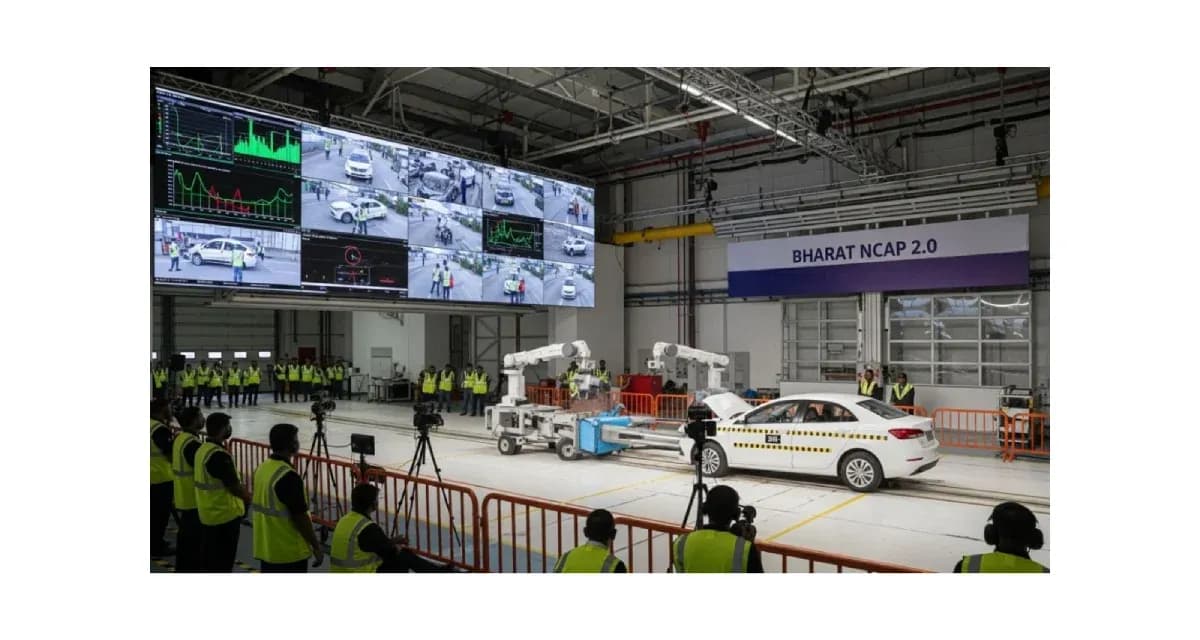
Bharat NCAP 2.0, a redesigned safety-rating system with five evaluation pillars, tighter scoring, and additional crash testing, is proposed by the Ministry of Road Transport and Highways (MoRTH).
The new protocol, which would raise the bar for vehicle safety and pedestrian/road-user protection, is scheduled to be implemented in October 2027. The draft is available for public comment until December 20, 2025.
The star rating will now be based on a total of 100 points, split among five crucial areas, under the proposed Bharat NCAP 2.0 (AIS-197 Revision 1).
| Assessment Pillar | Weightage (%) |
|---|---|
| Crash Protection | 55% |
| Vulnerable Road-User Protection | 20% |
| Safe Driving | 10% |
| Accident Avoidance | 10% |
| Post-Crash Safety | 5% |
Electronic Stability Control (ESC) and curtain airbags are prerequisites for any rating. Vehicles with seats that face sideways are ineligible for a grade.
A minimum of 70 points are needed for a 5-star rating in 2027–2029, while 80 points are needed in 2029–2031. Crucially, in order for a car to receive five stars, no evaluation pillar must have a zero score; also, red-zone injury values in crash testing may prohibit a top grade.
Extended Crash Tests for Practical Safety
Bharat NCAP 2.0 will employ five required crash tests on a vehicle's base model in order to more accurately represent real-world accident scenarios:
Frontal impact offset at 64 km/h
Full-width frontal impact at 50 km/h
Mobile deformable barrier side impact at 50 km/h
32 km/h oblique collision on the pole side
Mobile stiff rear impact at 50 km/h
To increase the realism of crash assessments, these new tests incorporate full-width frontal and rear-impact inspections that are absent from the current Bharat NCAP.
Safeguarding Two-Wheelers and Pedestrians: A First for India
Vulnerable Road-User Protection, which specifically targets motorcyclists and pedestrians, is one of the most significant features. In keeping with this pillar:
Leg-form impact tests measure the impact of a bumper on the legs of pedestrians.
Head-impact testing will evaluate how the bonnet and windshield are used to treat head injuries in both adults and children.
Motorcyclists and pedestrians will participate in optional testing for AEB (autonomous emergency braking) situations.
Technology and Post-Crash Procedures
Up to five of the eight technologies will be used to determine the score for the Safe Driving pillar. Among them are:
Hill-hold assistance, speed limit recognition, drowsiness alerts, lane departure warnings, blind spot detection, seatbelt reminders, and cross-traffic alerts.
ESC is required for Accident Avoidance, while AEB is optional but earns points.
Cars in the Post-Crash Safety category will be assessed based on:
Protection against electrical and fire hazards
Easy evacuation for occupants (door opening force, seat belt release)
SOS calls, multi-collision brakes, and rescue sheets are examples of optional features.
Timetable and Upcoming Actions
Public feedback on the Bharat NCAP 2.0 draft is welcome until December 20, 2025.
After the current regulations expire in October 2027, if accepted, the new standards will take the place of the Bharat NCAP system.
With this update, India's approach to vehicle safety has undergone a dramatic change from basic crash tests to a more comprehensive assessment that takes into account pedestrian protection, active safety features, and post-accident survivability. Car manufacturers are under pressure to incorporate increasingly sophisticated safety measures, and consumers will benefit from improved safety insights.
Also read: