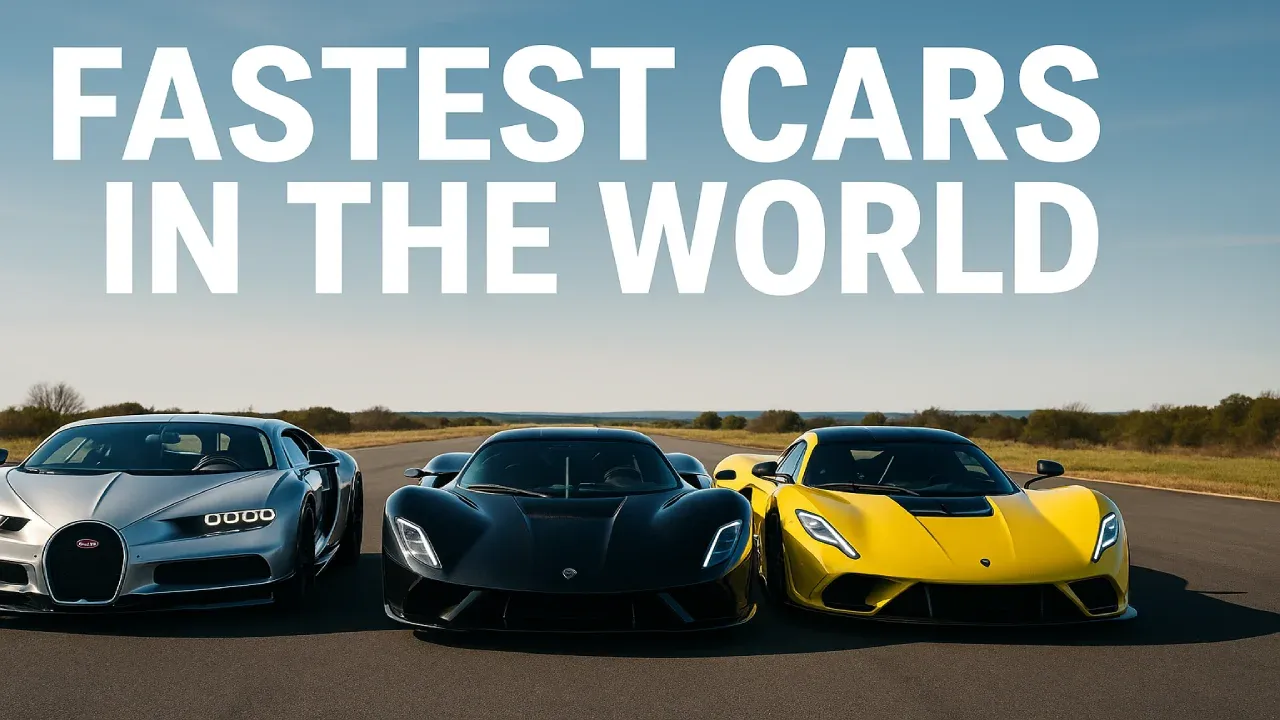
Picture a car doing over 300mph, faster than most light aircraft take off, and you're somewhere near what these machines are capable of.
A decade ago, that kind of number belonged purely to jet engines and land speed record attempts, not something you could technically buy and drive on a public road.
Now, it's a genuine talking point among hypercar makers, with brands old and new using everything from screaming naturally aspirated V16s to four-motor electric powertrains to chase the same target.
Below, you'll find 10 of these machines broken down one by one, with their official top speeds, prices and the engineering that gets them there, so you can see exactly how each one stacks up.
Which is the fastest car in the world 2026?
As things stand in 2026, the Koenigsegg Jesko Absolut holds the title, with a theoretical top speed of 310mph (500km/h). It's built with one job in mind: to go as fast as physically possible in a straight line. It hasn't officially run the top-speed course yet, but its design and engineering credentials make the claim hard to argue with.
Right behind it sits the Yangwang U9 Xtreme, which has actually completed a verified run at 308mph, making it the world's fastest production car with an official test result on record.
Which is the fastest car in the world in 2026?
Let’s take a closer look at the fastest car in the world - their ranking, speed and prices.
| Ranking | Car Model | Price | Top Speed |
|---|---|---|---|
| 1 | Koenigsegg Jesko Absolut | Not specified | 500 km/h (310 mph) |
| 2 | Yangwang U9 Xtreme | From roughly £200,000 | 496 km/h (308 mph) |
| 3 | SSC Tuatara | Not specified | 474.8 km/h (295 mph) |
| 4 | Bugatti Mistral | Not specified | 453.9 km/h (282 mph) |
| 5 | Bugatti Tourbillon | Around $4.6 million | 445 km/h (276 mph) |
| 6 | Hennessey Venom F5 | Not specified | 438 km/h (272 mph) |
| 7 | Rimac Nevera R | Around $2.5 million | 431 km/h (268 mph) |
| 8 | Aspark Owl | Around $3.2 million | 413 km/h (256 mph) |
| 9 | Czinger 21C V Max | Around $2.36 million | 407 km/h (253 mph) |
| 10 | McLaren Speedtail | Around $2.3 million | 403 km/h (250 mph) |
*The prices for the models may vary.
Koenigsegg Jesko Absolut (310mph)
This Swedish hypercar has the highest fastest car top speed on paper today: 310mph. It ditches heavy downforce parts for a sleek, low-drag shape with a drag coefficient of just 0.278 Cd. A 5.0-litre twin-turbo V8 makes up to 1,600bhp on E85 biofuel, paired with a 9-speed Light Speed Transmission. It weighs just 1,390kg, hits 0-100km/h in 2.5 seconds, and uses F-15-inspired tail fins for stability. Only 125 units will be built.
Yangwang U9 Xtreme (308mph)
Built by BYD's luxury sub-brand Yangwang, this car officially recorded a verified 308mph (496.22km/h) in September 2025 at the ATP Papenburg track in Germany, making it the fastest electric car in the world with a properly tested figure. It uses a 1,200-volt platform and four electric motors producing over 3,000 hp, hitting 0-100km/h in under 2 seconds. It also lapped the Nürburgring Nordschleife in 6:59.157. Only 30 units will be built, priced from roughly £200,000.
SSC Tuatara (295mph)
Named after a resilient New Zealand reptile, the Tuatara uses a bespoke 5.9-litre, flat-plane crank, twin-turbo V8 producing up to 1,750bhp. An earlier disputed 316 mph claim was retracted in 2020 over a GPS error. SSC returned in 2022 with a rigorously verified 295 mph (474.8km/h) run at the Kennedy Space Center, with telemetry showing it was still accelerating when it had to brake. It weighs 1,247kg dry, and only 100 units will ever be made.
Bugatti Mistral (282mph)
An open-top tribute to Bugatti's legendary 8.0-litre quad-turbo W16, producing 1,578bhp. In November 2024, Bugatti's chief test driver Andy Wallace hit a verified 282.04mph (453.9km/h) at Papenburg, officially making it the fastest convertible ever built. It does 0-100km/h in 2.4 seconds. All 99 units have already sold.
Bugatti Tourbillon (276mph)
Bugatti's replacement for the Chiron drops turbochargers entirely for a naturally aspirated 8.3-litre V16 built with Cosworth, adding three electric motors for a combined 1,800bhp, the most powerful Bugatti ever built. Top speed stands at 445km/h (276mph), with 0-60mph in under 2 seconds. Priced around $4.6 million, with 250 units planned.
Hennessey Venom F5 (272mph)
This Texas-built rocket uses a hand-built 6.6-litre twin-turbo V8 called "Fury," producing 1,817bhp sent purely to the rear wheels. It recorded a verified 272mph (438km/h) during validation testing at the Johnny Bohmer Proving Grounds in Florida, though Hennessey says the driver simply ran out of runway. It weighs 1,360kg dry, does 0-100km/h in 2.6 seconds, and only 24 units will be built.
Rimac Nevera R (268mph)
The track-focused version of Rimac's Nevera uses four independent electric motors making a combined 2,107bhp and 2,340Nm, sprinting 0-60mph in 1.74 seconds. Though limited to 258mph, an unrestrained run hit a verified 268.2mph (431.45km/h). It also completed 0-400-0km/h in 25.79 seconds. Only 40 units will be built, priced from around $2.5 million.
Aspark Owl (256mph)
Japan's first true electric hypercar, built by Aspark and assembled in Italy, stands just 99cm tall for one of the lowest centres of gravity of any road-legal car. Its quad-motor setup makes 1,980bhp, hitting 0-100 km/h in 1.75 seconds and 256mph (413km/h) flat out. It set two Guinness World Records in 2023 for electric-car speed over the eighth-mile and quarter-mile. Only 50 units are planned, priced around $3.2 million. Czinger 21C V Max (253mph) Built in California with two seats laid one behind the other, this AI-designed hypercar pairs a 2.88-litre twin-turbo V8 revving to 11,000rpm with twin front electric motors for a combined 1,250bhp. It does 0-60mph in 1.9 seconds and 253mph (407km/h) flat out. About 17% of its mass is 3D-printed. Only 80 units will be built, priced from around $2.36 million. McLaren Speedtail (250mph) McLaren's fastest road car ever, built around a carbon-fibre Monocage II structure with flexing rear ailerons. A 4.0-litre twin-turbo V8 hybrid makes 1,035bhp, taking it from 0-60mph in 2.9 seconds to a top speed of 250mph (403km/h). It seats three, driver centred. Just 106 units were hand-built in Woking, England, priced around $2.3 million.