Suppose you receive an e-Challan notice, ignore it, and it remains unpaid beyond the payment window.
What happens next?
The challan may be moved to a Virtual Court or a regular court for further legal proceedings. If you currently have a court challan, here is everything you need to know about it.
When does a challan move to court?
A traffic challan is generally moved to court in the following situations:
Non-payment within the given deadline: If an e-challan is not paid within the provided payment window of the violation, it is automatically forwarded to India's Virtual Court system or regular court.
Choosing to contest the challan: Selecting "Request to Contest" instead of paying transfers the case for a formal hearing rather than online settlement.
The offence requires judicial review: A court challan is directly issued in some serious traffic violation cases - drink and drive, etc.
A challan pending in court does not necessarily indicate serious wrongdoing. In several cases, it simply means the payment window has closed and the case has moved to the next stage of processing.
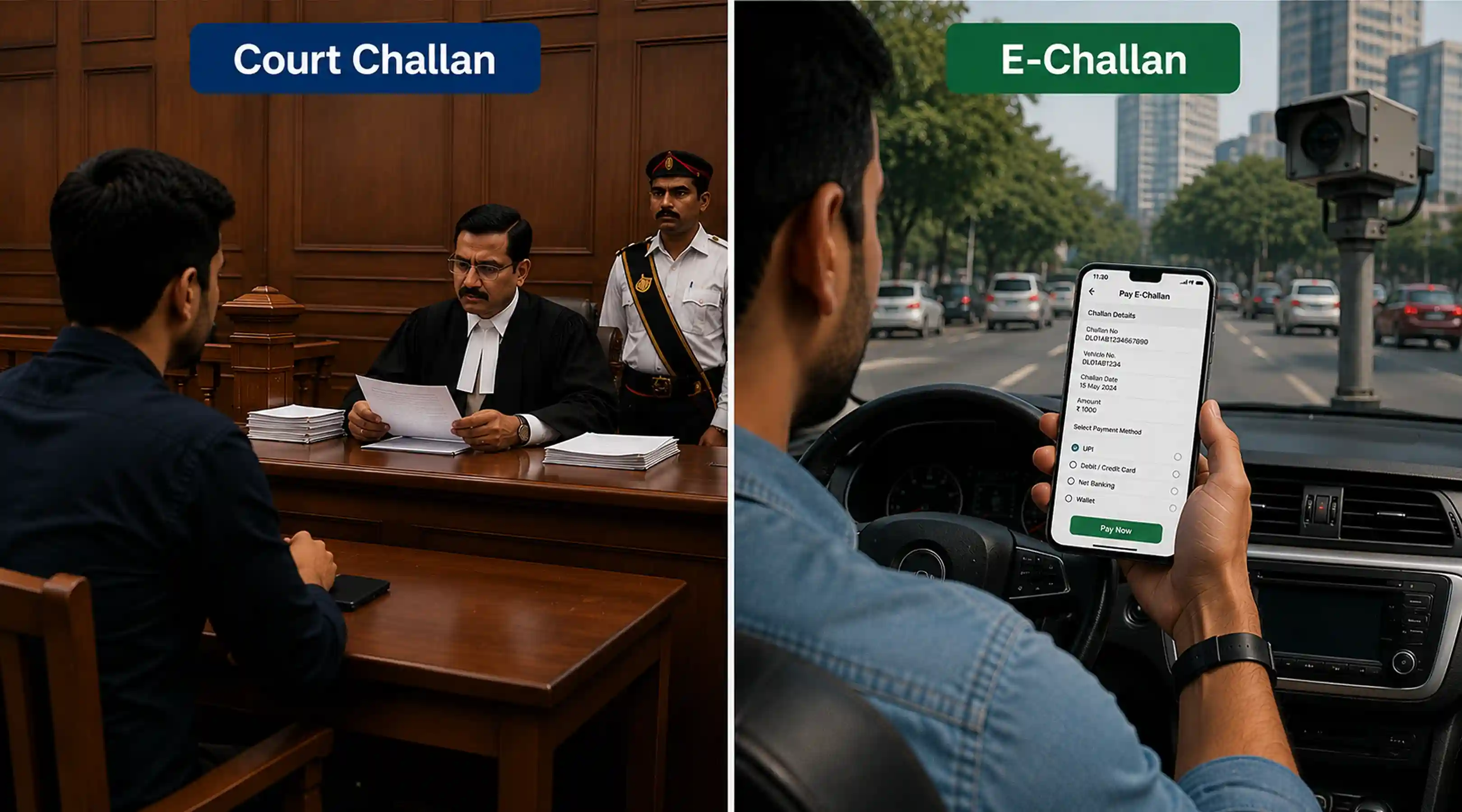
Difference between an E-Challan and a Court Challan
Below is a quick comparison of how traffic challan court payment usually differs from a simple online fine, since presence, penalty, and timing all depend on how serious the offence is.
| Feature / Aspect | E-Challan (Online) | Court Challan (Physical / Virtual) |
|---|---|---|
| Nature of Offence | Minor traffic violations | Major offences or long-overdue unpaid e-challans |
| Common Examples | Riding without a helmet, wrong parking, minor speeding | Drunk driving (Sec 185), rash driving, driving without a licence |
| Payment Mode | 100% online (Parivahan, Park+, State portals) | Payable in physical court or via Virtual Court platform |
| Personal Appearance | No (Settled completely online) | Yes (May require appearing before a Magistrate) |
| Penalty Amount | Fixed standard fine | Determined at the discretion of the Magistrate |
| Resolution Time | Instant (2–5 minutes) | Dependent on court schedule and hearing dates |
Traffic challan payment window timeline
Traffic fines are generally meant to be paid online within 60 days of the offence. If this deadline passes without payment, the unpaid e-challan is automatically forwarded to the Virtual Court system.
If the challan still remains unpaid after 90 days, the case is escalated further under Section 174 of the Motor Vehicles Act, 1988. At this stage, the consequences include:
Magistrate Summons: You may be issued an official legal summons to appear in person before a physical court magistrate.
Additional Penalties: The court may impose increased financial fines beyond the original challan amount.
Licence & Vehicle Restrictions: Risk of driving licence suspension, vehicle blacklisting on the Vahan portal, or denial of RTO services (such as PUC updates, insurance renewal, and vehicle transfer).
Note: The timeline may vary depending on the state or recent amendments to the law.
How to check if a challan has been sent to court?
The status of a challan can be checked through Park+ or Parivahan eChallan portal or the NextGen eChallan website, using the vehicle number, challan number, or registered mobile number.
The result shows whether the challan is still available for regular payment, has moved to the Virtual Court, or has been escalated to a physical court. If moved to court, the status will reflect as ‘Traffic challan sent to court’. This is the simple method for how to check court challan.
How to pay challan in court?
Traffic challan court payment works differently once a case is escalated to a regular court, either through non-payment beyond 90 days or because it involves a serious offence: it cannot be settled online, because judicial approval is required and only a magistrate can decide the final penalty.
Follow these step-by-step instructions to settle a traffic fine in court:
Verify Court Details Online: Check the vehicle number, type of offence, date, time, location, the name of the traffic court, and the hearing date.
Gather Required Documents: Carry both original documents and photocopies, including:
Valid Driving Licence (DL)
Vehicle Registration Certificate (RC)
Valid Motor Insurance Policy
Active Pollution Under Control (PUC) Certificate
Printout of the e-Challan / Court Notice
Appear in court on the given date: The case is called, the magistrate reviews the challan, and clarification may be requested. The person can plead guilty, explain mitigating circumstances, or contest the challan if it is believed to be incorrect.
The magistrate decides the penalty: Depending on the offence, this may be a fine, a temporary or permanent licence suspension, or in rare cases, imprisonment.
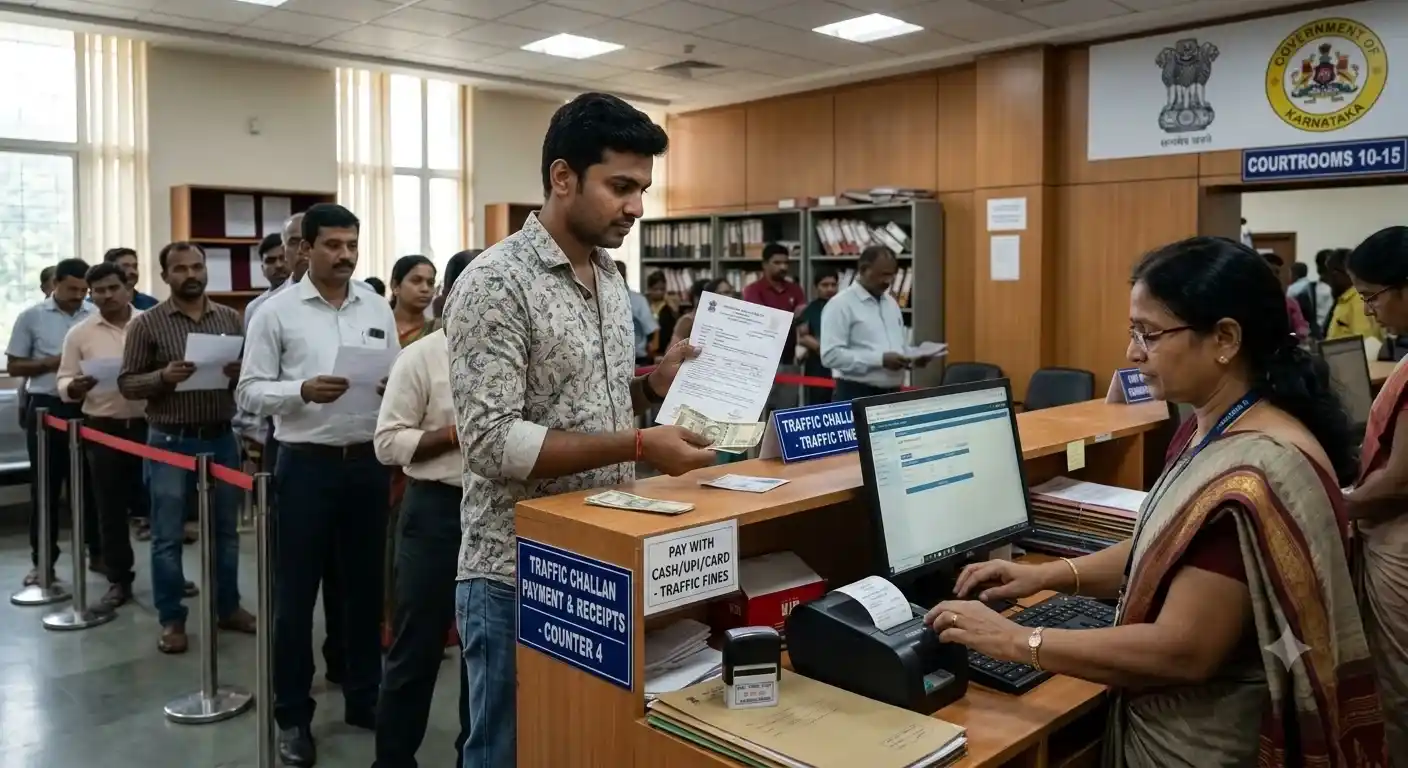
Pay fine & collect official receipt: Once the order is passed, payment is made at the designated counter, and an official receipt should be collected as proof of settlement.
Confirm the challan status online: After payment, the Parivahan eChallan portal can be checked to confirm the challan status has been updated.
How to pay a court challan without visiting the court?
Park+ helps people in settling court challan easily without needing them to physically visit the court. Instead, a lawyer is provided who handles the case from the very beginning, visits the court on behalf of the vehicle owner and settles the case.
What you will have to do is:
- Visit the ‘E Challan’ section on Park+ website or app.
- Check challan by entering your vehicle number.
- Proceed to pay challan by choosing a suitable payment method.
What will happen next?
- The lawyer assigned by Park+ will then collect the required documents (if required).
- Prepares an application and submit the same in the court for settlement.
- Upon the hearing and the final decision by the Judge, the challan is paid and disposed off from all databases.
- The payment receipt is then updated by a lawyer on Park+ for transparency and records.
Common reasons a direct court challan is issued
Wondering why a recently issued traffic ticket shows as ‘Court Challan’?
Well, in serious traffic offences, threatening the life of others, a direct Court Challan is issued. Such challans cannot be settled through the regular online payment process and must be dealt with before a magistrate:
Drunk driving (Section 185, Motor Vehicles Act) – A criminal offence where breath analyser results may be presented in court.
Dangerous or rash driving (Section 184) – Including overspeeding in high-risk zones, zig-zag driving, or racing on public roads.
Overloading or illegal vehicle modifications – Such as overloaded commercial vehicles or unapproved alterations.
Road accidents and hit-and-run cases - Particularly where there is injury, death, or property damage.
Repeat traffic offences - Where multiple unpaid or past violations lead to escalation even for offences that would otherwise be compoundable.
The Court Challan cases may differ based on the seriousness of the traffic offence.
Settling a challan via Lok Adalat or Evening Court
In some states, a challan transferred to court may be eligible for settlement through a Lok Adalat or an Evening Court, where such sessions are held. Eligibility depends on the nature of the offence, the court handling the case, and whether a settlement drive has been announced.
Where a case qualifies, Jury may reduce or waive part of the fine; in some instances, up to 75% of the fine has been waived for specific traffic challans. There is no fixed nationwide discount, and any reduction depends on the specific notification and the court's decision.
Consequences of Ignoring a Court Challan
Ignoring a challan pending in court can lead to further legal consequences, including:
The case remains active, with a higher penalty or possible legal action.
Court notices being issued.
A summons to appear, followed by further legal proceedings if ignored.
Driving licence suspension.
In serious cases, a non-bailable arrest warrant, vehicle impoundment, or other legal consequences.
Complications during RC transfer or insurance claims if challans remain unresolved.
Conclusion
Whether a challan is still within the payment window, sitting with the Virtual Court, or has been escalated to a physical hearing, the process for resolving it depends entirely on which stage it has reached. Checking the status regularly through the official portals is the simplest way to know which route applies, and acting before a deadline passes remains the most reliable way to avoid the higher fines, licence action, or court proceedings that follow when a challan is left unresolved.