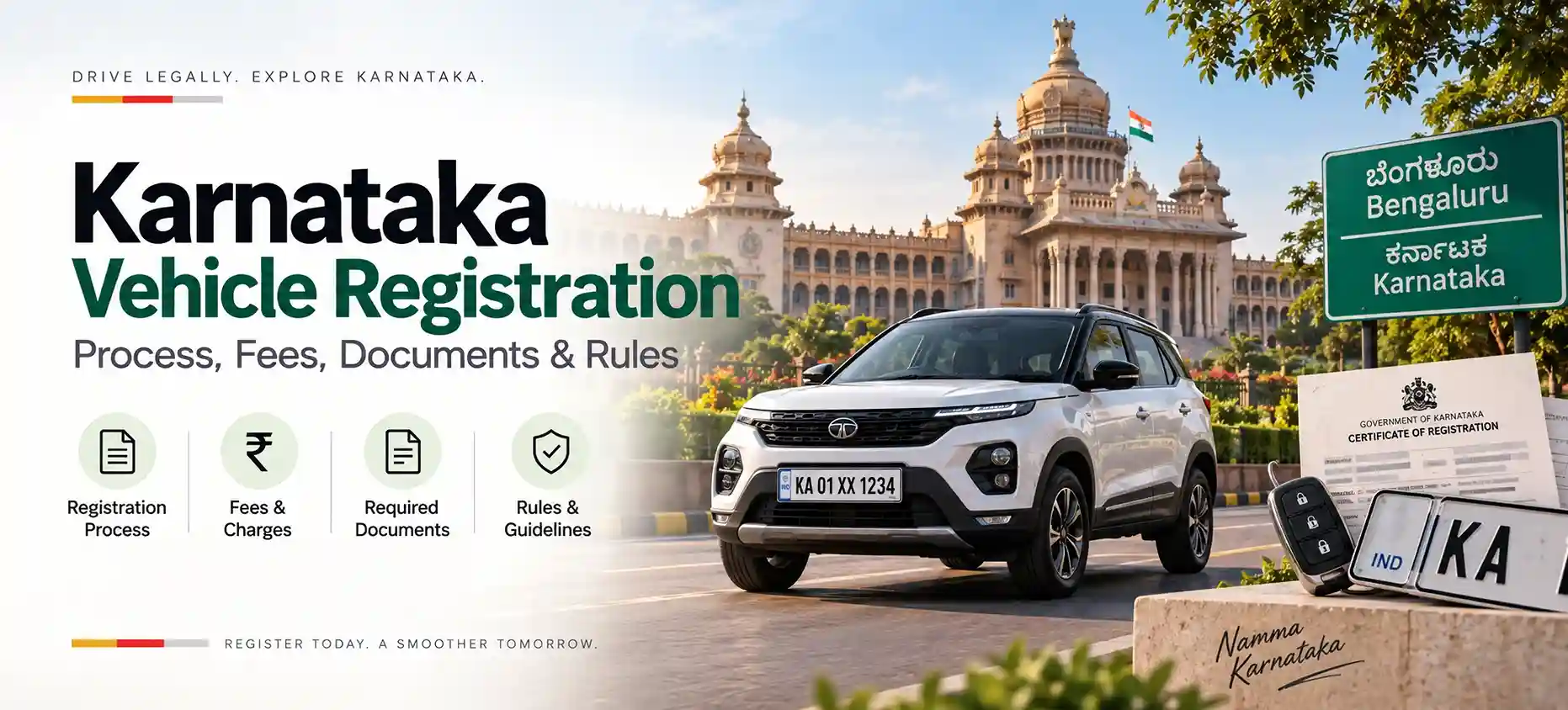
Buying a new car or bike in Karnataka?
Completing the Karnataka vehicle registration process is necessary before using the vehicle on public roads. The process involves submitting the required documents, paying applicable taxes and fees, and getting a registration number from the concerned RTO.
Here is a simple guide to the process, documents, charges and important rules.
What is Karnataka vehicle registration
Under Section 39 of the Motor Vehicles Act, 1988, a motor vehicle cannot be driven or permitted to be driven in a public place without being registered and displaying a registration mark as prescribed.
Vehicle registration creates an official record containing the vehicle's identification details and registered vehicle owner's information.
This documentation establishes legal ownership, enables third-party liability management, and issues your permanent Registration Certificate (RC smart card).
Types of vehicle registration in Karnataka
Before starting the process, it helps to understand the two main categories of Karnataka RTO registration:
Temporary Registration: Issued directly by the dealership when purchasing a brand-new vehicle. Valid for up to 30 days, this allows you to drive the vehicle safely to your local RTO or transport it across state borders.
Permanent Registration: Must be completed within 7 to 30 days of vehicle delivery. Permanent KA vehicle registration remains valid for 15 years for non-commercial (private) vehicles and 20 years for commercial vehicles, after which renewal is required.
Who needs vehicle registration in Karnataka?
Any individual or corporate entity purchasing a new motor vehicle for use in Karnataka must apply for registration. For new vehicles, the standard application is made using Form 20, which is submitted to the RTO holding jurisdiction over your residential or business address.
The step-by-step registration process in Karnataka
You can complete vehicle registration in Karnataka either through your dealership, directly online or in person.
Online Method via Parivahan Sewa
- Visit the official Parivahan Sewa portal.
- Navigate to Vehicle Related Services, choose ‘Vehicle Registration’ and select Karnataka as your state.
- Click on ‘Apply for New Registration’ and log in with your mobile number.
- Fill out the application details, upload required scanned documents, and pay the state road tax and registration fee online.
- Book an appointment slot for physical vehicle inspection at your designated Karnataka RTO.
Offline Method at the Local RTO
- Visit your local Karnataka RTO office.
- Submit the completed Forms 20, 21, and 22 along with identity and address proofs.
- Pay the applicable lifetime road tax and registration charges at the RTO cash counter.
- An Inspector of Motor Vehicles (IMV) will inspect the physical vehicle and verify the chassis imprint.
- Once approved, your new RC Smart Card will be printed and sent to your registered address via Speed Post.
Documents required for Karnataka RTO registration
Having your paperwork prepped in advance eliminates delays at the RTO counter or on the Parivahan portal. Ensure you keep original copies alongside self-attested photocopies:
- Application Forms: Form 20 (Application for Registration)
- Proof of Sale: Form 21 (Sales Certificate from Dealer/Manufacturer)
- Roadworthiness: Form 22 (Roadworthiness Certificate issued by manufacturer)
- Identity & Address Proof: Aadhaar Card, Passport, Voter ID, or Utility Bills
- Insurance and other vehicle documents: Valid insurance and other documents applicable to the vehicle and registration type.
- Tax & Financials: Dealer Invoice, PAN Card (or Form 60/61), and Form 34 (if vehicle is hypothecated via car loan)
Karnataka RTO fee and road tax structure
According to Karnataka RTO rules, lifetime motor vehicle road tax (LVT) must be paid up-front during registration. Karnataka levies a percentage of the vehicle's ex-showroom price, making it one of the most structured tax systems in India.
| Vehicle Category | Ex-Showroom / Invoice Cost | Road Tax (LVT Rate) |
|---|---|---|
| Two-Wheelers | Below ₹50,000 | 10% |
| Two-Wheelers | ₹50,000 to ₹1 Lakh | 12% |
| Two-Wheelers | Above ₹1 Lakh | 18% |
| Cars / LMVs | Below ₹5 Lakhs | 13% |
| Cars / LMVs | ₹5 Lakhs – ₹10 Lakhs | 14% |
| Cars / LMVs | ₹10 Lakhs – ₹20 Lakhs | 17% |
| Cars / LMVs | Above ₹20 Lakhs | 18% |
| Electric Cars (EVs) | Up to ₹10 Lakhs | 5% |
| Electric Cars (EVs) | ₹10 Lakhs – ₹25 Lakhs | 8% |
| Electric Cars (EVs) | Above ₹25 Lakhs | 10% |
Note: The final RTO bill includes an additional 11% Infrastructure & Urban Transport Cess calculated on top of the baseline road tax amount, plus a flat ₹1,000 safety/infrastructure cess for private cars. These may vary depending on the government regulations and recent updates.
How to get a KA vehicle registration number?
Every vehicle registered in the state receives a sequence starting with the state code KA, followed by a two-digit RTO code, a running alphabetical series, and a unique four-digit number (e.g., KA 01 MX 1234).
While a standard number is assigned sequentially by the system, owners can browse and bid for VIP, fancy, or specific choice numbers by paying an additional premium fee on the Parivahan portal.
Bringing a vehicle from another state to Karnataka
If you move to Karnataka with an out-of-state vehicle, you can drive it legally for up to 12 months. Beyond this period, you must re-register it locally:
- NOC: Obtain the No Objection Certificate from the original RTO.
- Road Tax Proof: Previous state's original road tax receipt along with proof of Karnataka road tax payment.
- Re-registration: Submit Form 27 along with your original RC, insurance, local address proof and PUC to secure a new KA number plate.
Before starting the process, check the requirements with the Karnataka RTO concerned to avoid submitting incomplete documents.
Wrapping Up!
Completing Karnataka vehicle registration is an essential step when buying a new vehicle or bringing a vehicle into the state. Keep the required documents ready, pay the applicable tax and fees, and follow the process prescribed by the concerned RTO or VAHAN. Understanding the registration process and Karnataka RTO rules can help you avoid delays and keep your vehicle records up to date.