New Traffic Rules in India 2026: Latest Fines, Rules & What Drivers Must Know
The new traffic rules 2026 have changed the way India enforces road safety, and if you haven't caught up yet, this guide is exactly where you need to start. Cameras, AI-based sensors, and automated e-challan systems now monitor violations in real time across major cities. You may not always see a traffic constable, but the fine will still find you. Here's everything you need to know, from fines and traffic rules and signals in India to developing smart habits that keep you safe and compliant.
India records one of the highest numbers of road fatalities globally, and most of these accidents are preventable. Overspeeding, drunk driving, ignoring signals, and riding without helmets remain the leading causes. The updated road and safety rules under the Motor Vehicles Act are designed to build a culture of responsible driving, not just collect fines. Enforcement is now automated, penalties are sharper, and violations that once ended with a quick roadside warning now go straight to court.
The theme for 2026 is “Sadak Suraksha Jeevan Raksha,” and in this context, the state government and concerned authorities have added some new rules. The additions/changes to the traffic rules 2026 are:
One of the most significant and least talked about changes under the new traffic rules 2026 is the five-strike policy, effective from January 01, 2026. As per the rule, any driver who accumulates five or more violations within a single calendar year faces licence suspension or cancellation. The count runs from 1 January to 31 December and resets annually. Critically, even minor offences count, such as an expired PUC, a missed seatbelt, or a glance at a mobile phone at a signal. None are dismissed as trivial under this framework. Before cancellation, a show-cause notice is issued. But the safest approach is simply not to accumulate violations. Five in a year is more reachable than most drivers realise.
Enforced on April 22, 2026 in Delhi, particularly, the ‘No PUCC, No Fuel’ policy states that if the driver does not have a valid PUCC, he will not be able to buy fuel (petrol/diesel/CNG) and will be liable to pay a fine of ₹10,000. This initiative is taken to combat the rising air pollution. In precise terms, not having a vehicle PUC Certificate will attract a double whammy, meaning ‘No fuel + Hefty fines’.
This rule was brought in effect from January, 2026 to tackle the problem of unpaid challans. Under this, the MoRTH has provided a strict timeline of 45 days to settle the challan or raise a dispute against it. In the event that no action is taken by the challan holder within the provided timeline, the challan will be deemed as ‘Accepted’.
Moreover, if the challan remains unpaid even after 30 days from the date the 45-day window closes, the RTO services might be blocked or it could even lead to suspension of the Driving Licence.
Considering the child's safety as a major concern, the Central government directed the imposition of stricter penalties against the violations endangering the lives of the innocent. A few cases that fall under it are:
Children not wearing helmets (2 wheelers)/seatbelts (4 wheelers).
More passengers are riding on the 2-wheeler.
Seating arrangement in a moving vehicle that threatens the lives of the passengers.
The ITMS (Integrated Traffic Management System), AI cameras, etc., for detecting traffic violations have been implemented to ensure no traffic offence goes unnoticed. The AI keeps an eye on every single violation, small or big, such as lane violations, jumping red lights, etc. to make sure people drive safely and adhere to the traffic rules.
It is important to draw a clear distinction here: the following are violations and their penalties. Fine amounts represent general benchmarks; actual figures vary by state, as each state sets its own challan rates within the limits of the central Motor Vehicles Act.
| Violation | Fine (1st Offence) | Fine (Subsequent) |
|---|---|---|
| Driving without a valid licence | ₹5,000 | ₹5,000 |
| No helmet (rider + pillion) | ₹1,000 | ₹1,000 + disqualification |
| No seatbelt (all occupants) | ₹1,000 | ₹1,000 |
| Mobile phone while driving | ₹5,000 | ₹10,000 |
| Drunk driving | ₹10,000 | ₹15,000 + imprisonment |
| Overspeeding (light vehicles) | ₹1,000–₹2,000 | ₹2,000 |
| Overspeeding (heavy vehicles) | ₹2,000–₹4,000 | ₹4,000 |
| Jumping a red light | ₹5,000 | ₹10,000 |
| Driving without insurance | ₹2,000 | ₹4,000 |
| No PUC certificate | ₹10,000 | ₹10,000 |
| Not giving way to an ambulance | ₹10,000 | ₹10,000 |
| Driving without valid RC | ₹5,000 | ₹10,000 |
| Triple riding on two-wheeler | ₹1,000 | ₹1,000 |
| No-honking zone violation | ₹1,000 | ₹2,000 |
| Juvenile offence (by guardian) | ₹25,000 + 3 yrs imprisonment | – |
*Fines shown are indicative and may vary by jurisdiction, court orders, vehicle class, and repeat violations.
Many accidents happen not because drivers are unfamiliar with the traffic rules and signals in India, but because they choose to ignore them.
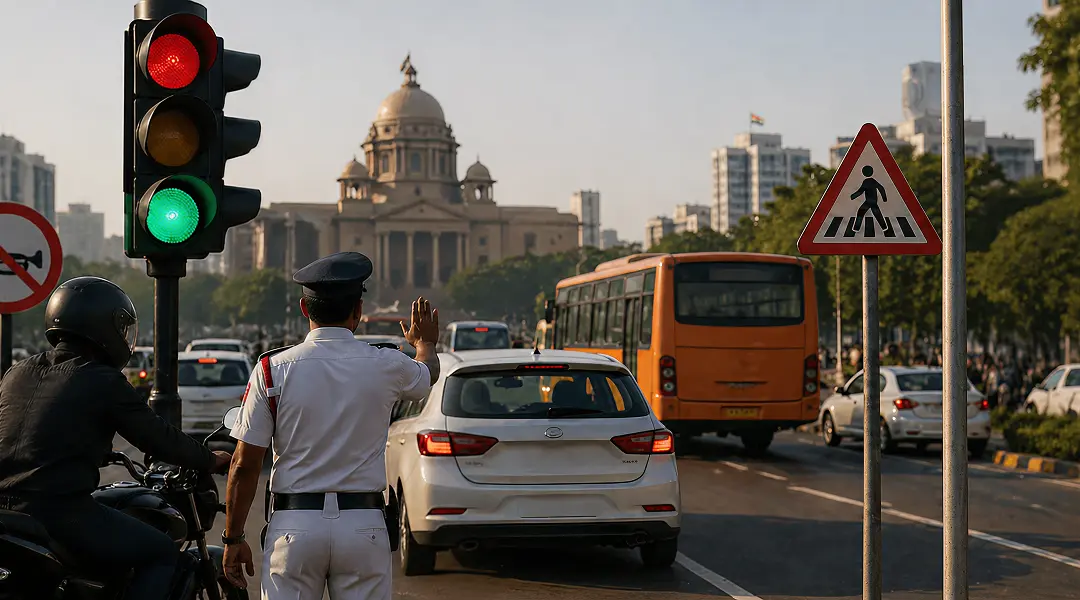
The rules at traffic lights are straightforward. The traffic light works as follows:
Red: Stop completely, behind the stop line. Not on it, not past it.
Amber/Yellow: Prepare to halt. Not an invitation to accelerate.
Green: Proceed only after checking for pedestrians and cross-traffic.
Under the updated traffic rules in India 2026, crossing the stop line on red or entering an intersection on amber now qualifies as dangerous driving under Section 184, attracting a court challan. Pictures on road safety rules and photos of traffic rules published by official government channels regularly highlight stop-line violations as among the most frequently penalised offences. Traffic safety rules pictures and pictures of traffic rules shared in public awareness campaigns are worth consulting if you're unsure of the correct stop positions.
The updated Indian road rules are stricter than ever on lane discipline. Weaving between lanes, straddling two lanes, or driving against traffic flow are all enforceable violations, especially on expressways and national highways.
Honking near hospitals, schools, or courts attracts ₹1,000 for the first offence and ₹2,000 for any subsequent one. A pressure horn goes straight to ₹5,000.
A document check can happen at any time. Under the updated road traffic safety rules, these are mandatory. The motorists have to carry these documents either physically or digitally via DigiLocker or the mParivahan app:
Beyond the fines, these road safety rules exist to make every journey safer. A few habits that genuinely matter:
The new traffic rules 2026 are firmer, smarter, and harder to avoid than ever before. Cameras are watching, challans are automated, and fines are steep. But the spirit of these road safety rules is not punitive; it is protective. Follow the road rules, carry your documents, keep your insurance valid, and never drive under the influence. Use Park Plus to take the stress out of parking. And remember: the safest drivers are those who respect the traffic rules in India, not because a camera is watching, but because they understand why those rules exist.
As per 2026, the payment window for challans is now trimmed to 45 days, implementation of the five-strike rule, digital monitoring of violations, double penalty for violation of child safety and No PUCC, No Fuel (in Delhi).
Riders must wear BIS-compliant helmets with fastened straps, carry a valid license and active insurance, maintain a current PUC certificate, and avoid using a mobile phone while riding.
Yes. Both the rider and pillion must wear ISI/BIS-approved helmets with a properly fastened strap. A loose or non-standard helmet still attracts the ₹1,000 fine.
Red means a full stop behind the line. Amber means prepare to halt. Green means proceed only after checking for pedestrians and cross-traffic.
Yes. DigiLocker and the mParivahan app are legally recognised across India. Physical copies as backup are still a sensible precaution.
Your driving license may be suspended and you could receive a court summons. Paying promptly avoids additional consequences.
Yes. The seatbelt rule under the road and safety rules applies to all occupants, including rear passengers.