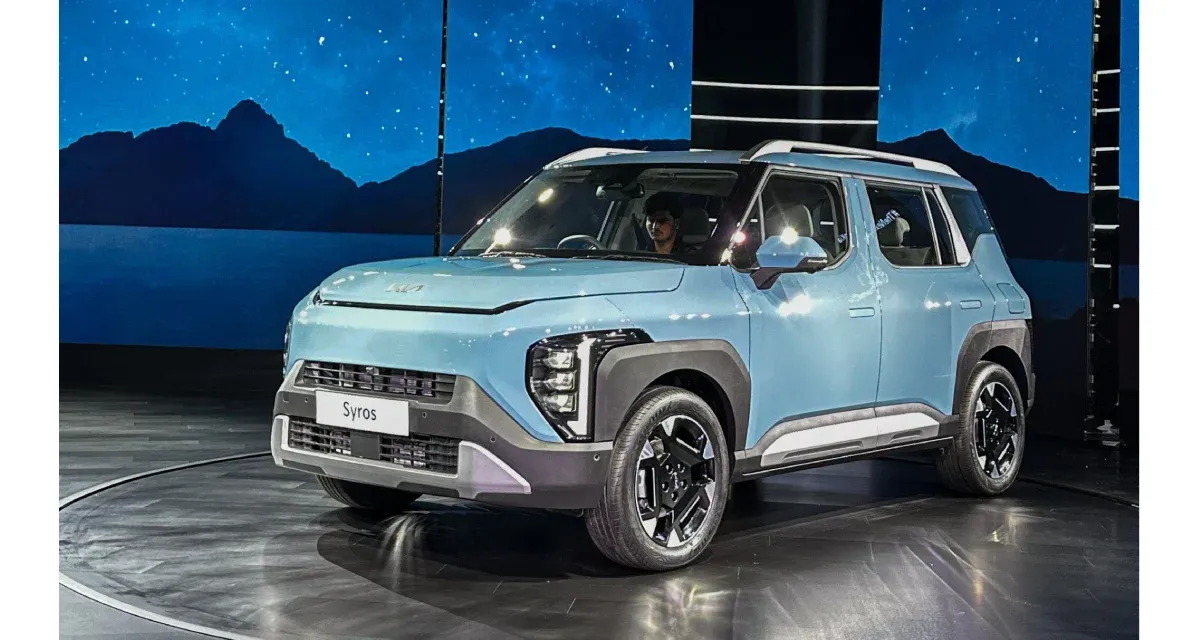
Kia Syros EV Caught Testing in India, Here's What the Spy Shots Reveal
The Kia Syros EV has been spied on Indian roads with notable design revisions, including a charging flap, neon green brake callipers, and a reworked rear bumper, giving us our clearest look yet at the electric variant.
Expected to arrive later in 2026, priced between ₹19 lakh and ₹25 lakh, the Syros EV will take on the Tata Nexon EV, MG Windsor, and Mahindra XUV 3XO EV on the K1 platform borrowed from the Hyundai Inster.
It seems Kia's been busy. A heavily camouflaged test mule of the Syros EV has been snapped on Indian roads, and even beneath all that disguise tape, it's giving plenty away. The unmistakable boxy silhouette, that tall, squared-off stance that made the petrol-powered Syros an instant head-turner, is clearly intact. But look a little closer, and the differences begin to emerge.
Most tellingly, there's a charging flap sitting on the front-left quarter panel, the giveaway that this is no ordinary Syros. The 17-inch alloy wheels appear to be carried over from the internal combustion engine (ICE) version, but they now wear neon green brake calipers, a sporty touch that Kia has previously used on the Seltos. It's a small detail, but one that signals Kia wants the EV to feel distinct without straying too far from the established design.
The rear bumper on the test mule looks noticeably different from the standard Syros, with a mix of body-coloured and blacked-out panels, though the camouflage wrap makes it tricky to read exactly what's going on. The roof rails have also been revised, most likely to improve aerodynamic efficiency, which is a priority on any EV where every bit of drag affects the claimed range.
The front end retains the vertically stacked LED headlamps with their distinctive L-shaped daytime running lamps, the ADAS radar sensor, and the 360-degree camera setup , all familiar faces from the petrol and diesel models. That said, Kia may well offer a revised front bumper on the production version to give the EV a cleaner, more differentiated look.
The interior of the test mule hasn't been spotted yet, but based on how Kia handled the Carens Clavis EV, which carried over almost the entire cabin from its ICE sibling, it's a reasonable bet that the Syros EV will do the same. That means you're likely looking at the dual 12.3-inch screens, the touch-based air conditioning panel, a panoramic sunroof, wireless phone charging, and ventilated front and rear seats, all of which feature on the standard Syros.
What the EV version is likely to add on top of that is vehicle-to-load (V2L) and vehicle-to-vehicle (V2V) charging capabilities, features that allow the car to power external devices or even charge another electric vehicle, increasingly common on modern EVs and genuinely useful in day-to-day life.
Kia has confirmed that the Syros EV will ride on the K1 platform, the same architecture that underpins the Hyundai Inster EV sold in international markets. The car will be front-wheel drive only, and while Kia hasn't officially confirmed battery specifications for India, the global Inster EV offers two options: a 42kWh pack and a 49kWh pack, with claimed ranges of up to 300km and 355km on the WLTP cycle, respectively. Those are the figures most watchers are working with as a baseline for the Indian-spec Syros EV, though the actual numbers may differ once the car is adapted for local conditions and homologated on Indian testing cycles.
With a high degree of expected localization, Kia is aiming to keep the Syros EV competitively priced, something that will be crucial in a segment that's becoming increasingly crowded.
The Syros EV is expected to arrive with a starting price of around ₹19.05 lakh (ex-showroom), stretching up to approximately ₹25.99 lakh for the fully loaded variants. That puts it squarely in the ring with some well-established names, the Tata Nexon EV, the MG Windsor EV, and the Mahindra XUV 3XO EV, among them. It will also be positioned below Kia's own Carens Clavis EV, making it the most affordable electric vehicle in the Korean brand's Indian line-up.
Given that the Syros petrol already earned a five-star BNCAP safety rating and ships with Level 2 ADAS, a premium audio system, and a thoughtfully designed cabin, the electric version has a strong foundation to build on.
If Kia can price it aggressively and deliver meaningful real-world range, the Syros EV could well become one of the more compelling options in its class when it arrives later in 2026.
Also read: