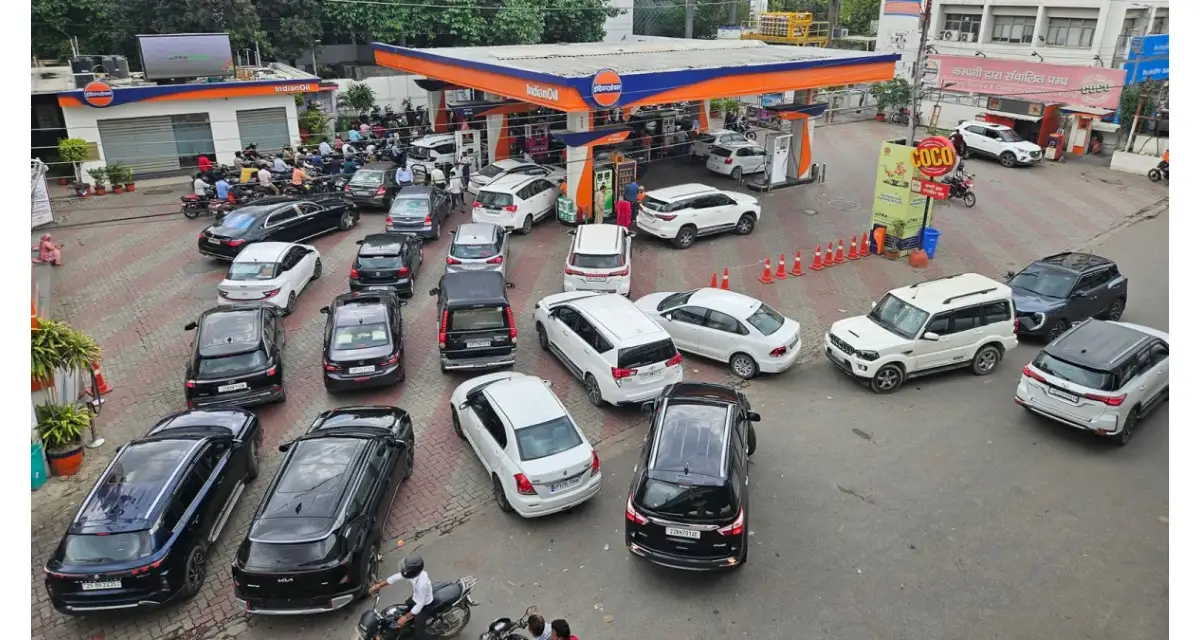
India Caps Bulk Fuel Buys at Retail Pumps
India's petroleum ministry has ordered a 90-day clampdown on bulk fuel buying at retail stations, restricting diesel sales to 200 litres per customer daily.
State oil firms are losing rupees per litre on subsidised retail fuel as commercial buyers exploit the price gap between pump and bulk supply rates.
There is a certain irony in the fact that it was not ordinary drivers causing the problem. While most people visit a petrol pump to fill a tank and move on, a growing number of commercial operators have found something far more lucrative in those same forecourts.
Trucking firms, factories, and institutional buyers had quietly worked out that retail pump prices, kept artificially low by government policy, were considerably cheaper than the market-linked rates charged at dedicated bulk supply points.
The arithmetic was straightforward. With state-run oil companies absorbing a loss of roughly 36.5 rupees per litre on diesel sold at the pump, and around 9 rupees per litre on petrol, bulk consumers who shifted their purchases to retail outlets were effectively receiving a subsidy never intended for them.
Over time, this quiet migration of commercial demand began to strain retail supply in certain regions, leaving regular motorists and households competing with industrial-scale buyers at neighbourhood fuel stations.
The government moved to address this on June 11, 2026, when the Ministry of Petroleum and Natural Gas published a formal order placing temporary controls on fuel sales through retail outlets.
Under the new rules, diesel purchases at retail stations are capped at 200 litres per customer or vehicle per day. Commercial, industrial, and institutional consumers are directed to return to designated bulk supply points for their requirements, and reselling any fuel obtained through retail channels is explicitly prohibited.
The measures carry a lifespan of up to 90 days from the date of issue, though the government retains the option to lift them earlier should circumstances change.
The domestic pricing problem has arrived at an awkward moment internationally. India's order pointed directly to the US-Israeli conflict with Iran as a source of mounting strain on global petroleum supply chains, with disruptions to shipping routes and reduced availability of crude affecting markets well beyond the immediate conflict zone.
For a country that imports the majority of its crude oil requirements, the combination of geopolitical uncertainty and internal supply mismanagement presented a situation that demanded a measured response.
Indian Oil Corporation, Bharat Petroleum Corporation, and Hindustan Petroleum Corporation together operate roughly 90 per cent of India's more than 100,000 retail fuel stations.
As a net exporter of refined petroleum products, India has the refining capacity to meet domestic needs, but selling fuel domestically at below-cost rates has been steadily eroding the financial position of these three state-run entities. The surge in commercial buyers taking advantage of subsidised retail prices only deepened those losses.
By redirecting bulk consumers back to market-priced supply channels, the order attempts to restore both the intended purpose of retail outlets and some measure of commercial sanity to the companies bearing the subsidy burden.
Also read: