Hyundai Bayon-Based Compact SUV Spied Testing in India
Spy shots of the Hyundai Bc4i reveal Venue-like split lighting and a Bayon-inspired side profile.
The SUV is expected to debut a new hybridised 1.2-litre turbo-petrol engine when it launches in India.
Hyundai's upcoming Bayon-based compact SUV, internally known as the Bc4i, has been caught testing on Indian roads for the first time. The sighting comes ahead of its anticipated launch in the second quarter of FY2027, which translates to the July–September 2026 period.
Positioned to slot between the Exter and the Venue in Hyundai's domestic line-up, the Bc4i is clearly a significant product for the Korean carmaker in India.
The front end of the Bc4i carries a split-style headlight arrangement that will feel immediately familiar to anyone who has seen the current Venue.
Slim LED daytime running lamps sit at the top of the cluster, while earlier spy shots from Korea had also shown black cladding on the lower bumper section, front parking sensors, and a radar unit indicating ADAS capability. The lower headlight units housing the main beam sit further down on the bumper.
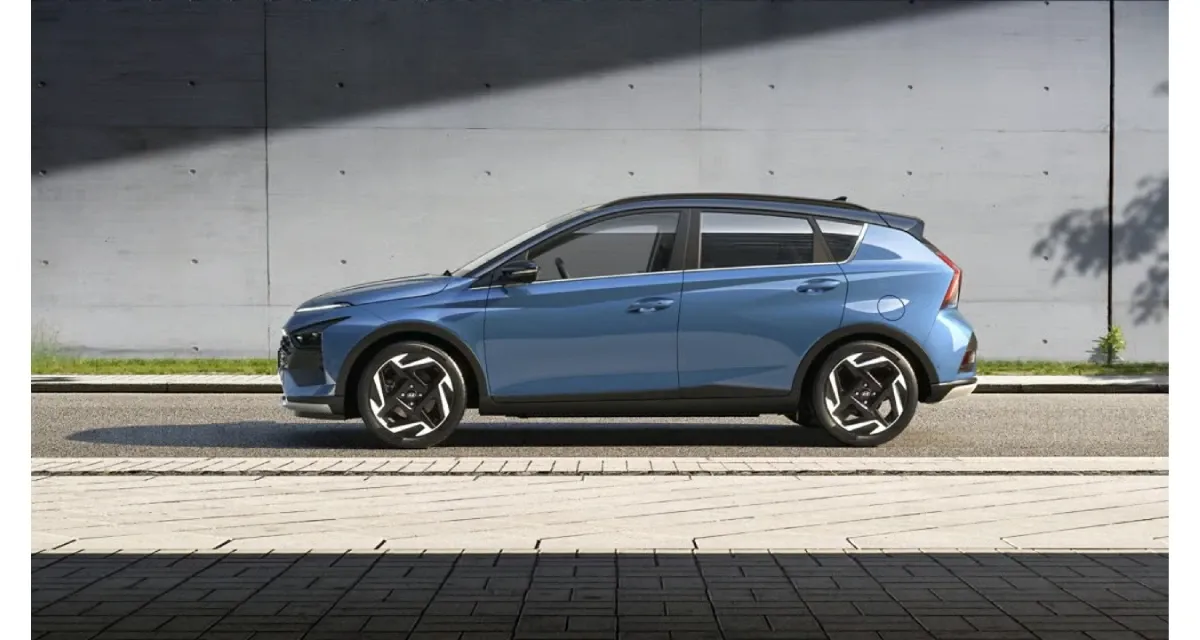
In profile, the Bc4i's windowline bears a strong resemblance to the international-spec Bayon sold in markets such as Europe and the Middle East. The alloy wheels appear to sport a distinctive piston-shaped design, though their exact dimensions have not been confirmed. The current Bayon in global markets rides on 16-inch rims.
At the rear, the lighting layout mirrors the split-style theme seen up front, with the lower section housing the brake lights and the upper section likely carrying LED turn indicators and reversing lights. Silver roof rails and a rear parking camera with sensors are also visible on the test mule.
The interior of the India-spec Bc4i has not yet been spotted. However, the N-Line variant of the same SUV was previously spied in Korea, giving a partial glimpse of what the cabin architecture might look like. That prototype featured all-black seats with red contrast piping and adjustable headrests.
The standard model is expected to follow a similar layout without the sporty trim. Whether Hyundai will offer a 360-degree camera remains an open question, given that the Venue currently does without one.
Hyundai is reportedly developing a new 1.2-litre turbocharged petrol engine specifically for the Indian market, and the Bc4i is the likely candidate for its debut. This unit is expected to offer more power and torque than the current 1.0-litre turbo-petrol while being more frugal than the 1.5-litre option.
Notably, this engine is expected to come with a hybrid system, fitting neatly into Hyundai's stated plan of introducing eight hybrid models in India by 2030. Lower trims of the Bc4i are expected to continue with the familiar 1.0-litre turbo-petrol that currently does duty in the i20 N Line and the Venue.
On pricing, the Bc4i is likely to be positioned in a similar bracket to the Venue, which currently ranges from Rs 8 lakh to Rs 15.65 lakh (ex-showroom). Its rivals in the compact SUV space would include the Maruti Fronx, Toyota Taisor, Renault Kiger, and Nissan Magnite.
Also read: