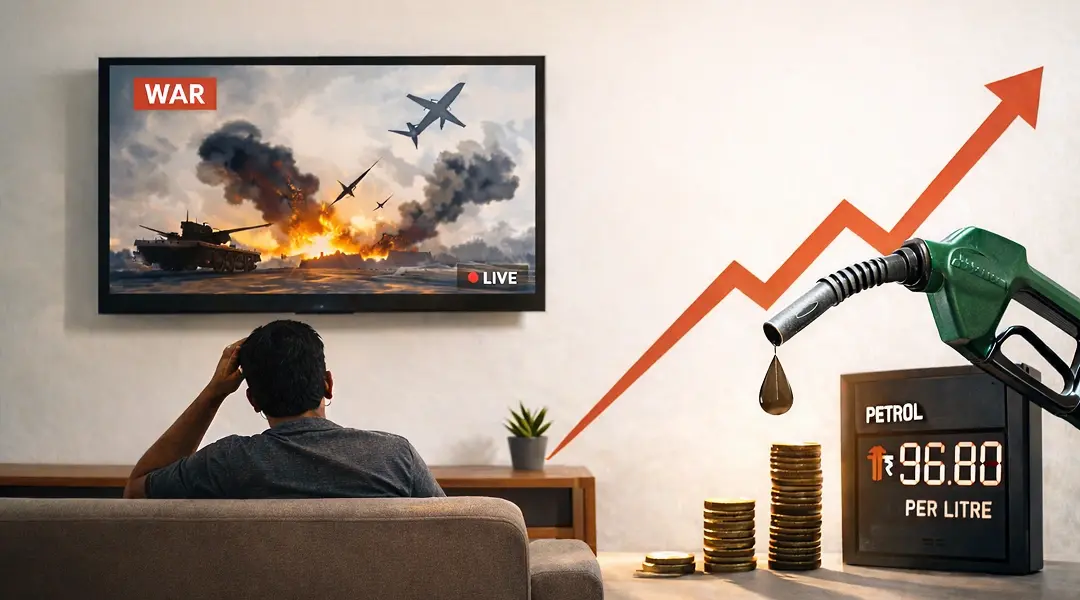
Will Petrol Price Increase in India Due to War? - The Global Oil Crisis
Will Petrol Price Increase in India Due to War? - The Global Oil Crisis
Global wars in major oil-producing regions often affect oil prices, which can influence the cost of petrol in countries, eventually.
India imports a large share of the oil it consumes, meaning international events can directly impact fuel costs in the country. When global oil markets become unstable, concerns about a petrol price increase in India begin to grow and see a petrol shortage in India or worse - a full-blown petrol crisis in India?
Concerns about a petrol price hike are increasing as Brent crude oil prices have recently crossed the $100 per barrel mark. This rise is largely linked to tensions around the Strait of Hormuz, one of the world’s most important oil transport routes. Nearly 20% of the world’s oil supply passes through this narrow passage.
Even a small disruption or blockade in this region can quickly affect the global oil price. When supply becomes uncertain, markets react immediately. In economic terms, this situation is often described as a “risk premium.”
They do this because they fear that shipments may be delayed, rerouted, or transported at a much higher cost, which could eventually lead to a petrol crisis in India and other countries.
At present, the answer to the question “Is petrol price going up in India?” depends largely on global market conditions and domestic pricing policies.
As of March 2026, petrol prices today in India have remained relatively stable. Retail fuel prices are influenced by several factors, including international crude oil prices, refining costs, transportation expenses, and government taxes.
However, global developments still play an important role. If conflicts disrupt major shipping routes used to transport oil, supply delays could push prices higher. In such situations, speculation about whether petrol prices will increase tends to grow rapidly.
Currency movements also influence fuel costs. If the Indian rupee weakens against the US dollar, importing crude oil becomes more expensive, which can further contribute to a petrol price increase.
Several factors could potentially lead to a petrol price hike in India if global tensions escalate. One option is adjusting excise duty, a tax imposed on fuel. Reducing taxes temporarily can help offset rising global oil prices and keep petrol price today more affordable for consumers. Another important measure is the use of strategic petroleum reserves. State-run oil companies such as Indian Oil Corporation (IOCL), Bharat Petroleum (BPCL), and Hindustan Petroleum (HPCL) build profits when global oil prices are low.
When petrol prices increase due to global tensions or war, these companies absorb some of the extra cost to prevent an immediate petrol price hike for consumers.
The Indian government is currently using several measures to keep petrol prices today from rising sharply. These include using strategic oil reserves, importing discounted Russian crude oil, and asking oil marketing companies to absorb short-term losses. Together, these steps are helping manage the risk of a sudden petrol price hike.
For now, the answer to the question “Is petrol price going up in India?” is: not immediately. However, the situation is still being closely monitored. Consumers should stay informed because fuel prices follow a dynamic pricing system. This means the government can delay a price increase for some time, but it cannot completely avoid it.
Looking after the crisis, it is anticipated that the petrol price in Delhi are expected to rise. Check out the daily petrol prices of your state on Park+ and stay informed about the fluctuations.
Other Park+ Services : FASTag, Vehicle Owner Details, E-Challan, New Cars, Car Insurance
Right now prices are unstable because of tensions in the Middle East. A price drop will mainly depend on whether the conflict in important shipping routes comes under control.
At present, there is no oil shortage in India. The country keeps emergency reserves and imports oil from multiple countries to avoid supply problems
Petrol prices can increase if a war affects oil supply from the Middle East. Indian oil companies are currently absorbing the costs to keep retail petrol prices stable for consumers.
Iran currently offers the world's cheapest petrol at approximately ₹0.02–₹0.03 USD per litre, followed closely by Venezuela due to heavy state subsidies.
No, India’s oil imports from Iran have almost entirely dried up since 2019 due to US sanctions, with India now sourcing primarily from Russia.
In recent years, China has been the biggest buyer of Iranian oil. Due to international sanctions, many countries reduced imports, but China continued purchasing large amounts of crude from Iran