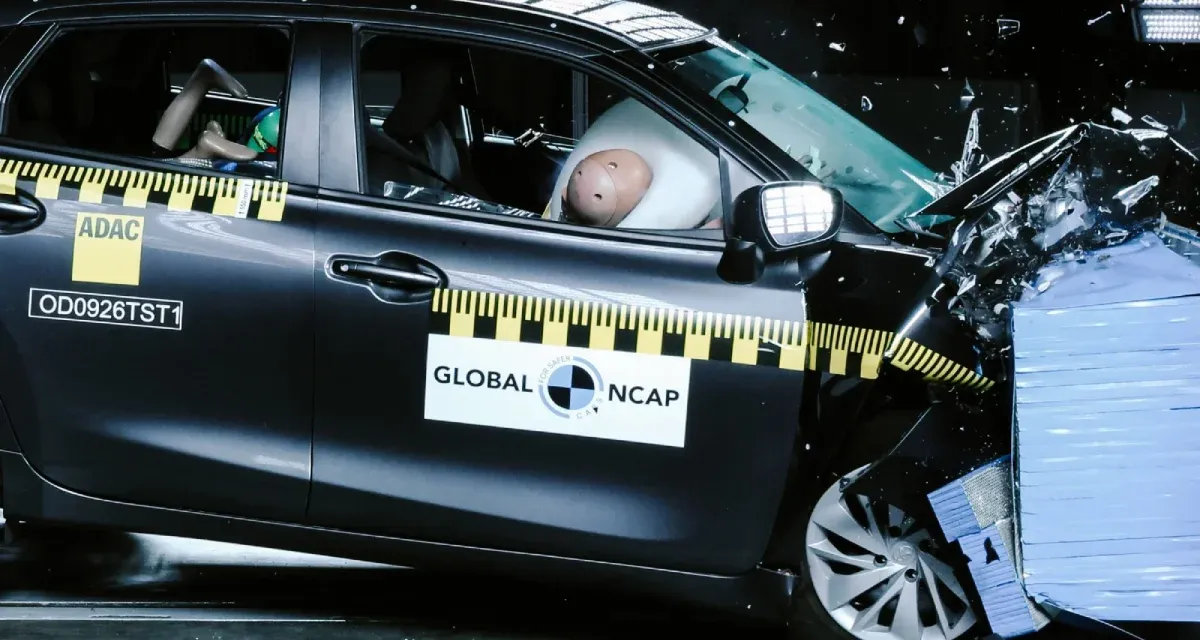
Toyota Starlet Scores Zero Stars in Global NCAP Crash Test
When a car scores zero out of zero in Adult Occupant Protection, there is little ambiguity about where it stands on safety. That is precisely the situation the Toyota Starlet finds itself in after Global NCAP published its latest round of crash test results.
The Africa-spec hatchback, manufactured at Maruti Suzuki's Gujarat plant in India and exported to the continent, managed no points whatsoever in the Adult Occupant Protection category.
The result is difficult to overlook, particularly given the Starlet's strong sales presence across African markets.
Breaking down the numbers, the Starlet scored 0/0 in AOP (Adult Occupant Protection) and 29.33 out of 49 in COP (Child Occupant Protection), earning three stars in the latter category. While the child safety performance is at least something to work with, the adult score is, plainly speaking, a full stop on the matter.
Global NCAP also flagged the car's bodyshell integrity as unstable, which is a significant structural concern. The version submitted for testing came fitted with just two airbags and Electronic Stability Control as standard.
| Test Category | Score | Star Rating | Remarks |
|---|---|---|---|
| Adult Occupant Protection (AOP) | 0 / 0 | 0 Stars | No points scored |
| Child Occupant Protection (COP) | 29.33 / 49 | 3 Stars | Partial performance |
| Bodyshell Integrity | N/A | N/A | Rated as unstable |
| Airbags (Standard) | 2 | N/A | ESC included as standard |
Global NCAP was not slow to draw attention to the wider implications of these results. The organisation noted that the Starlet's popularity in African fleet markets means it sees a broader and more intensive range of road use, which statistically raises the likelihood of accidents.
A car used by a greater variety of drivers, across varying road conditions, ought to meet a higher bar for occupant protection, not a lower one.
To its credit, Toyota did not remain silent during the testing process. The manufacturer informed Global NCAP that an updated version of the Starlet is on its way, one that will include additional airbags and improved safety features. Global NCAP has confirmed it will re-test the updated model once it arrives in the African market.
It is also worth noting that the Maruti Baleno, which shares its underpinnings with this platform and received updated safety equipment, scored four stars in Bharat NCAP testing.
However, that same model managed only two stars in Latin NCAP, suggesting that results vary quite considerably depending on the specification and market for which a car is prepared.
The Starlet situation is a reminder that the version of a car sold in one market is not always the version tested or celebrated elsewhere.
For buyers and regulators in Africa, these results are a serious prompt to ask harder questions about the minimum safety standards being applied to high-volume, affordable vehicles in their region.
Also read: