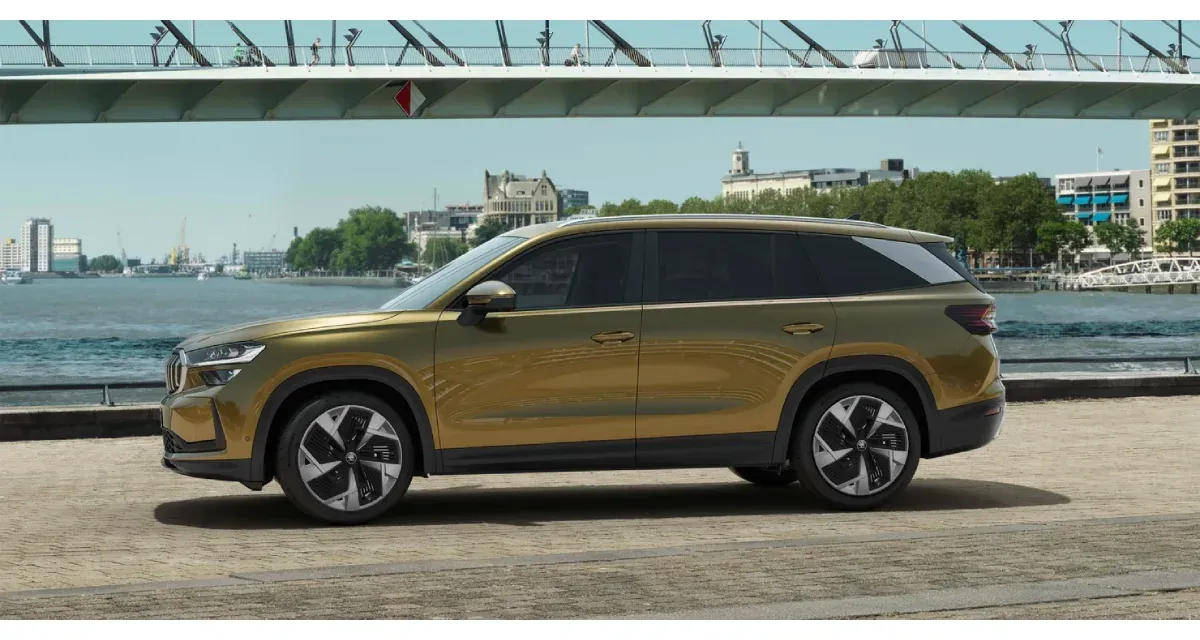
Skoda Kodiaq RS Spotted Ahead of June 22 Unveil
The Kodiaq RS arrives as a CBU with VRS badging, red brake callipers, and RS-specific 20-inch Hankook alloys, setting it apart from the standard model.
Power jumps significantly over the regular Kodiaq, with the RS producing 261bhp and 400Nm, enabling a 0 to 100kmph sprint in 6.3 seconds.
With less than a week to go before its official debut, the Skoda Kodiaq RS has been spotted in India, giving us our clearest look yet at what the Czech brand has in store. The unveil is set for June 22, 2026, and based on what has been seen, the RS badge carries genuine weight this time around.
Finished in a bold red shade, the Kodiaq RS announces itself with purpose. VRS badges feature on the grille, on the front seat motifs, and at the rear, leaving little doubt about the car's sporting intent.
The front end adopts the signature RS grille seen on the Octavia RS, though the Kodiaq RS incorporates a larger air vent area to suit its bigger proportions. Red stitching runs through the leather upholstery inside, tying the cabin's sporty theme together cohesively.
One of the more telling details spotted on the Kodiaq RS is the set of 20-inch Hankook tyres mounted on the signature RS alloys. This firmly points to the car arriving as a completely built unit, unlike the standard Kodiaq, which is locally assembled in India.
Adding to the RS-specific visual package are the red brake callipers, which peek through the alloy spokes with the sort of confidence that befits a performance-oriented SUV. The interior also retains the 13-inch infotainment screen carried over from the standard version.
Mechanically, the Kodiaq RS uses the same 2.0-litre TSI petrol engine and 7-speed DSG combination as the standard car, but with noticeably more muscle. Where the regular Kodiaq produces 201bhp and 320Nm, the RS version dials those figures up to 261bhp and 400Nm.
The result is a 0 to 100 km/h time of 6.3 seconds, which is genuinely brisk for a seven-seater SUV of this size. If Skoda prices it sensibly, the Kodiaq RS has every chance of making a compelling case for itself as the segment's performance benchmark.
Also read: