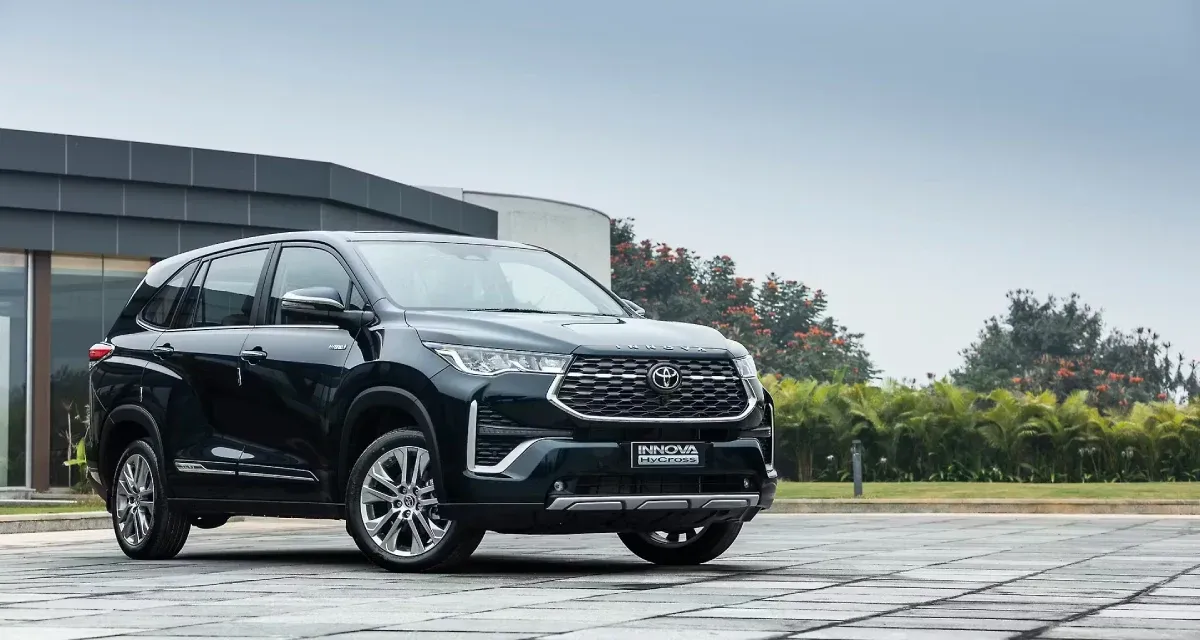
Innova HyCross Hits 2 Lakh Sales as Toyota India Posts 17.41% Growth in April 2026
Last month was a productive one for Toyota Kirloskar Motor. The company moved 32,086 units in total, bettering its April 2025 tally of 27,329 by 4,757 vehicles - a gain that works out to 17.41% growth on a year-on-year basis. The bulk of those sales was generated within India, where retail demand continues to gain confidence with every passing quarter.
Measuring performance against the immediately preceding month tells a slightly different story. Volumes in April were 14.14% below the 35,125 units registered in March 2026, though that kind of sequential softening is well within normal range for the period that follows the financial year-end, when pent-up demand tends to be front-loaded into March.
| Period | Units Sold | Compared Against | Difference | Difference |
|---|---|---|---|---|
| April 2026 | 30,159 | April 2025 (YoY) | +5,326 | +21.45% |
| April 2025 | 24,833 | March 2026 (MoM) | -4,966 | -14.14% |
| March 2026 | 35,125 | — | — | — |
Tucked within the monthly data is a figure that carries more weight than the rest. The Innova HyCross, Toyota's full-hybrid MPV that sits at the upper end of the family vehicle market, crossed the two-lakh cumulative sales threshold during April.
That figure is a milestone in more ways than one. It marks the first time a premium hybrid people carrier has gathered this level of acceptance in a market where buyers have historically been reluctant to pay a price premium for an electrified drivetrain.
The gap between domestic and export volumes widened noticeably in April. India-bound retail sales of 30,159 units were up 21.45% against the 24,833 units in the corresponding month of last year.
Exports, by contrast, slipped from 2,496 units to 1,927 units, a contraction of 22.80%. While the overseas numbers are worth watching, they represent a relatively contained portion of the company's overall business, and the domestic surge was more than sufficient to hold overall performance in positive territory.
| Segment | April 2026 | April 2025 | Difference | Change |
|---|---|---|---|---|
| Domestic | 30,159 | 24,833 | +5,326 | +21.45% |
| Exports | 1,927 | 2,496 | -569 | -22.80% |
| Total | 32,086 | 27,329 | +4,757 | +17.41% |
Widening the lens to cover January through April 2026 reveals an even more encouraging picture. Toyota has accumulated total sales of 1,37,194 units across these four months, a 19.14% improvement on the 1,15,157 units sold in the same window a year prior.
The domestic tally for this period stands at 1,26,651 units, reflecting 19.71% growth, whilst exports contributed 10,543 units, up 12.65% year-on-year. These are not figures that suggest a company coasting; they point to a brand that has built genuine momentum in a competitive market.
| Segment | Jan-Apr 2026 | Jan-Apr 2025 | Difference | Change |
|---|---|---|---|---|
| Domestic | 1,26,651 | 1,05,798 | +20,853 | +19.71% |
| Exports | 10,543 | 9,359 | +1,184 | +12.65% |
| Total | 1,37,194 | 1,15,157 | +22,037 | +19.14% |
With the hybrid narrative firmly established, Toyota is now preparing to take its next step. The company has confirmed it will enter the pure-electric segment in India with a model called the Ebella. Preparations and testing are already underway, and the launch is expected in the near future.
For a brand that has spent years earning trust through the reliability and fuel efficiency of its self-charging hybrids, the move into battery-electric territory feels like a logical progression. The Ebella is set to broaden what Toyota can offer the growing number of buyers actively seeking a zero-emission everyday vehicle.
Also read: