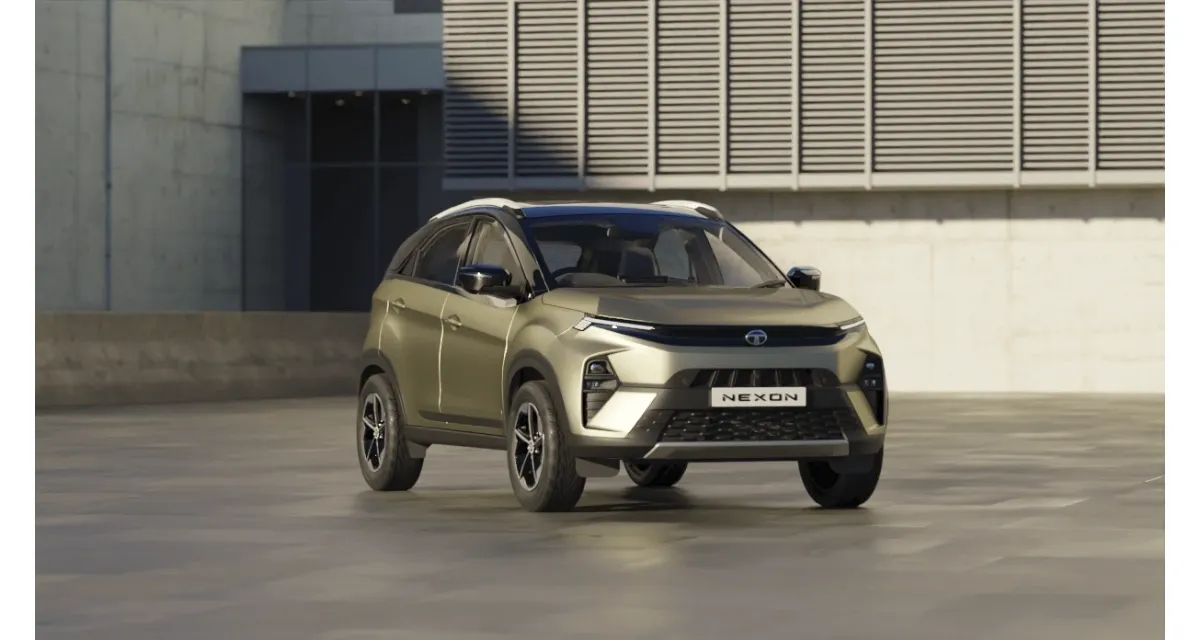
1M and Counting - How the Tata Nexon Became India's Best-Selling Compact SUV
The Tata Nexon has become the first passenger vehicle from Tata Motors to cross the one-million cumulative sales mark, a milestone achieved in February 2026.
Launched originally in September 2017, the sub-4-metre SUV has grown year after year to become one of India's highest-selling models in its class. The Nexon alone accounts for roughly 30 per cent of Tata's total passenger vehicle sales, making it the cornerstone of the brand's retail performance.
The Nexon debuted with 14,062 units in its partial first year of 2017. By 2018, its first complete calendar year on sale, the model surged to 52,519 units, a staggering growth of 273.48%. That same year, it earned a 5-star rating in Global NCAP crash tests, which gave buyers a strong reason to choose it over rivals on safety grounds alone.
Sales held relatively steady at 49,312 units in 2019 before dipping marginally to 48,842 units in 2020, as both a broader market slowdown and the Covid-19 pandemic disrupted the industry.
In January 2020, Tata gave the Nexon its first significant facelift, bringing BS6 compliance, a sharper design and additional features. The same year also saw the introduction of the Nexon EV, which opened up an entirely new buyer base.
The impact of both moves became clear in 2021, when annual sales more than doubled to 1,08,577 units the first time the Nexon crossed the one-lakh annual sales mark. In 2022, growth continued at pace, with sales reaching 1,68,278 units, up 54.98% over the prior year.
The second major facelift arrived in 2023, introducing split LED headlamps, sequential LED DRLs, a new illuminated Tata logo on the steering wheel, and 10.25-inch screens for both the infotainment system and instrument cluster.
The Nexon EV was also updated, gaining a 12.3-inch touchscreen along with vehicle-to-vehicle (V2V) and vehicle-to-load (V2L) charging capabilities. Annual sales for 2023 came in at 1,70,312 units, a modest 1.21% rise on the year prior.
| Year | Annual Sales (Units) | Change YoY (Units) | Change YoY (%) |
|---|---|---|---|
| 2017 | 14,062 | — | — |
| 2018 | 52,519 | +38,457 | +273.48 |
| 2019 | 49,312 | -3,207 | -6.11 |
| 2020 | 48,842 | -470 | -0.95 |
| 2021 | 1,08,577 | +59,735 | +122.30 |
| 2022 | 1,68,278 | +59,701 | +54.98 |
| 2023 | 1,70,312 | +2,034 | +1.21 |
| 2024 | 1,61,611 | -8,701 | -5.11 |
| 2025 | 2,00,561 | +38,950 | +24.10 |
Red bars indicate years with a year-on-year sales decline.
Sales fell slightly in 2024 to 1,61,611 units, a decline of 5.11%. However, the Nexon came back strongly the following year.
In 2025, it posted its highest-ever annual sales of 2,00,561 units, crossing the 2-lakh barrier for the first time with 24.10% year-on-year growth. Adding to this momentum, the updated Nexon was tested by Global NCAP in 2024 and received a 5-star rating for both adult occupant protection and child occupant protection.
A significant factor behind the Nexon's sustained appeal is the sheer variety it offers. Buyers can choose from petrol, diesel, CNG and battery electric variants, allowing the model to serve a wider audience than most of its competitors.
The twin-cylinder CNG setup deserves a special mention as it resolved the long-standing boot space concern that had plagued CNG vehicles. Special editions, including Dark, Red Dark and Kaziranga, have also added a layer of exclusivity and helped sustain buyer interest.
With close to 80 variants currently available, the Nexon remains one of the most comprehensively specced offerings in the sub-4-metre SUV segment.
Tata is reported to be working on a second-generation Nexon, which will be built on a heavily updated version of the existing X1 platform. The new model is expected to feature a more contemporary design, improved technology and enhanced safety.
Powertrain options are largely anticipated to carry over, though the future of the diesel variant remains uncertain in light of the upcoming CAFE 3 emissions norms.
Also read: