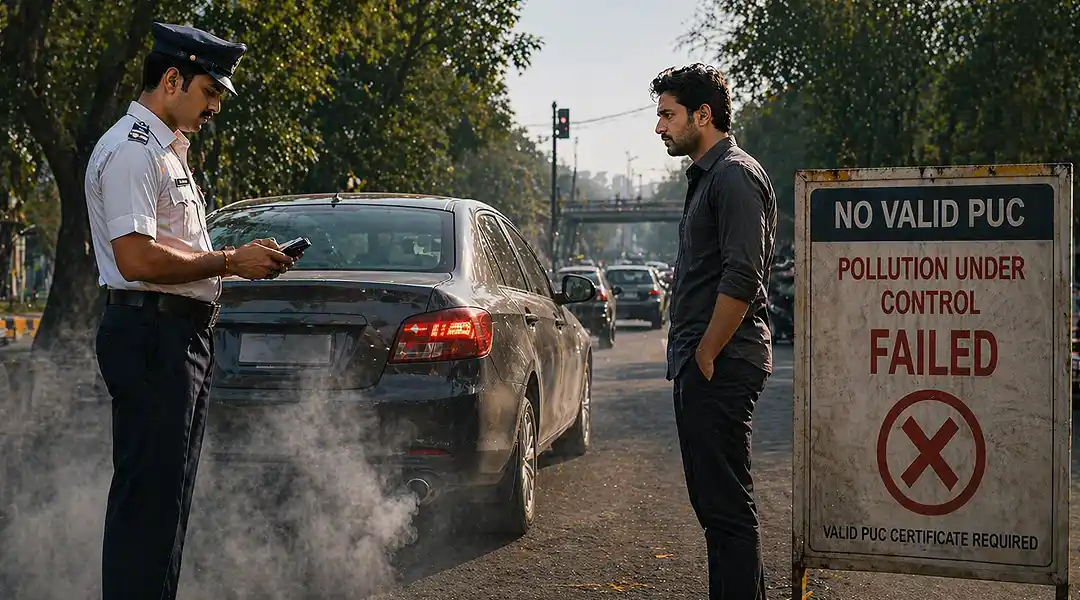
PUC Challan In India: What Happens If You Drive Without a Valid PUC in India
PUC Challan In India: What Happens If You Drive Without a Valid PUC in India
Driving in India comes with important responsibilities, and ensuring your vehicle follows pollution rules is one of the most critical. If you are caught driving without a valid Pollution Under Control (PUC) certificate, you may face a PUC challan, heavy fines, and even legal action.
Under the Motor Vehicles Act, 1988, penalties for non-compliance have increased significantly. This guide explains everything about the challan for pollution certificate, including fines, rules, validity and how to avoid penalties.
A Pollution Under Control (PUC) certificate is an official document issued by the government after testing a vehicle’s pollution levels. It confirms that the smoke emitted by your vehicle is within the permissible limits set by the Central Motor Vehicles Rules.
Whether you drive a petrol, diesel or CNG vehicle, having a valid PUCC (Pollution Under Control Certificate) is mandatory.
A valid certificate includes the following:
Without this document, you risk receiving a PUC challan in India during inspections.
A PUC certificate is not just a legal requirement; it plays a vital role in environmental protection and vehicle performance. Ignoring it can quickly lead to a challan without a pollution certificate.
Driving without a valid certificate can lead to serious consequences beyond just fines. A PUC challan may be issued instantly through traffic police or automated systems.
Under the latest amendments to the Motor Vehicles Act (Section 190(2)), the penalties for PUC challans are strict and uniform across most states. While the central law sets a high ceiling, the actual pollution certificate challan you pay depends on the local enforcement in your region.
| Offence Category | Fine Amount | Additional Legal Consequence |
|---|---|---|
| First Offence | Up to ₹10,000 | Possible 3-month DL suspension |
| Subsequent Offence | Same to ₹10,000 | Risk of vehicle registration suspension |
| Fake/Tampered PUCC | ₹10,000+ | Possible 6-month imprisonment and vehicle seizure |
Note: The PUC challan fine may vary across states based on applicable state regulations and enforcement policies.
If you have received a challan without pollution certificate documentation, you can settle it using the following methods:
Driving a vehicle without a PUC challan settlement, can lead to serious legal and financial consequences. Traffic authorities now use digital systems to track unpaid fines, making it difficult to avoid penalties.
You can perform a validity check through digital and physical methods to ensure you don’t risk a PUC challan:
If you prefer a manual check, you can verify your hard copy PUC certificate obtained from the testing centre. The validity date is clearly stated on the printed slip, usually located near the bottom or alongside the vehicle details.
If you find the certificate is out of date, immediately visit a nearby certified PUC testing station to renew it and avoid a heavy pollution certificate challan.
Regularly checking your Pollution Under Control (PUC) certificate is essential to staying compliant with traffic laws and avoiding unnecessary penalties. It not only helps you prevent a PUC challan but also ensures your vehicle is operating within safe emission limits.
Renewing your certificate is a quick process and significantly cheaper than paying a PUC challan.
Find an Authorised Centre: Visit any authorised emission testing centre.
Petrol Pump: Go to any RTO-approved petrol pump for a PUC test.
RTO-Approved Vans: In different areas, vans check the PUC, making it convenient for people.
Here’s the approximate cost of the PUC test: - Two-wheelers: ₹60–₹80 - Petrol cars: ₹80–₹100 - Diesel vehicles: ₹100–₹150
The validity of a Pollution Under Control (PUC) certificate is essential to avoid a PUC challan and stay compliant with traffic regulations in India. The validity period depends on whether your vehicle is new or already in use.
Getting a PUC certificate is simple and requires minimal documentation, which helps you avoid any issues with PUCC challan checks later.
Vehicle Registration Certificate (RC): Primary document required for issuing the PUC.
Previous PUC Certificate: Helpful for quick renewal and record tracking.
Vehicle for Testing: Your vehicle must be physically present for emission testing.
Basic Vehicle Details: Registration number is used to generate the certificate.
Avoiding a PUC challan in India is simple if you follow a few basic practices. Here are some smart tips to help you stay compliant and avoid penalties:
Renew on Time: Always renew your PUC certificate before expiry to avoid a PUC challan and stay legally compliant.
Set Reminders: Use mobile alerts to track expiry dates and prevent a challan without a pollution certificate.
Keep a Digital Copy: Store your PUC certificate on your phone for quick verification during checks.
Check Status Online: Regularly verify your certificate through a PUCC challan check to avoid surprises.
Maintain Your Vehicle: Regular servicing helps keep emissions low and reduces the risk of penalties.
A PUC challan is simple to avoid. By spending around ₹100 and just 10 minutes every six months, you can save yourself from a ₹10,000 fine and legal trouble. Stay updated, keep your vehicle pollution in check and always verify your PUCC challan check status before going on a long trip.
Renew your PUC certificate before it expires and keep a digital copy to avoid a challan without a pollution certificate.
New vehicles come with a PUC certificate valid for one year from the date of registration. You only need to renew it after the first year.
No, the physical emission test must be conducted at a certified centre. However, you can download the certificate online once the test is done.
In Uttar Pradesh, the fine for driving without a valid PUCC is ₹10,000, often treated as a spot fine by authorities.
No, since EVs have zero tailpipe emissions, they are exempt from the PUC requirement.