Court Challan vs E-Challan: Difference & Payment Process in India
Court Challan vs E-Challan: Difference & Payment Process in India
Following traffic rules is essential while driving on Indian roads. If a traffic rule is violated, the driver may face legal penalties and challans.
In the digital era, traffic penalties are no longer simple paper receipts handed over by an officer. Instead, the process now includes both electronic challans and formal court-related penalties for serious violations.
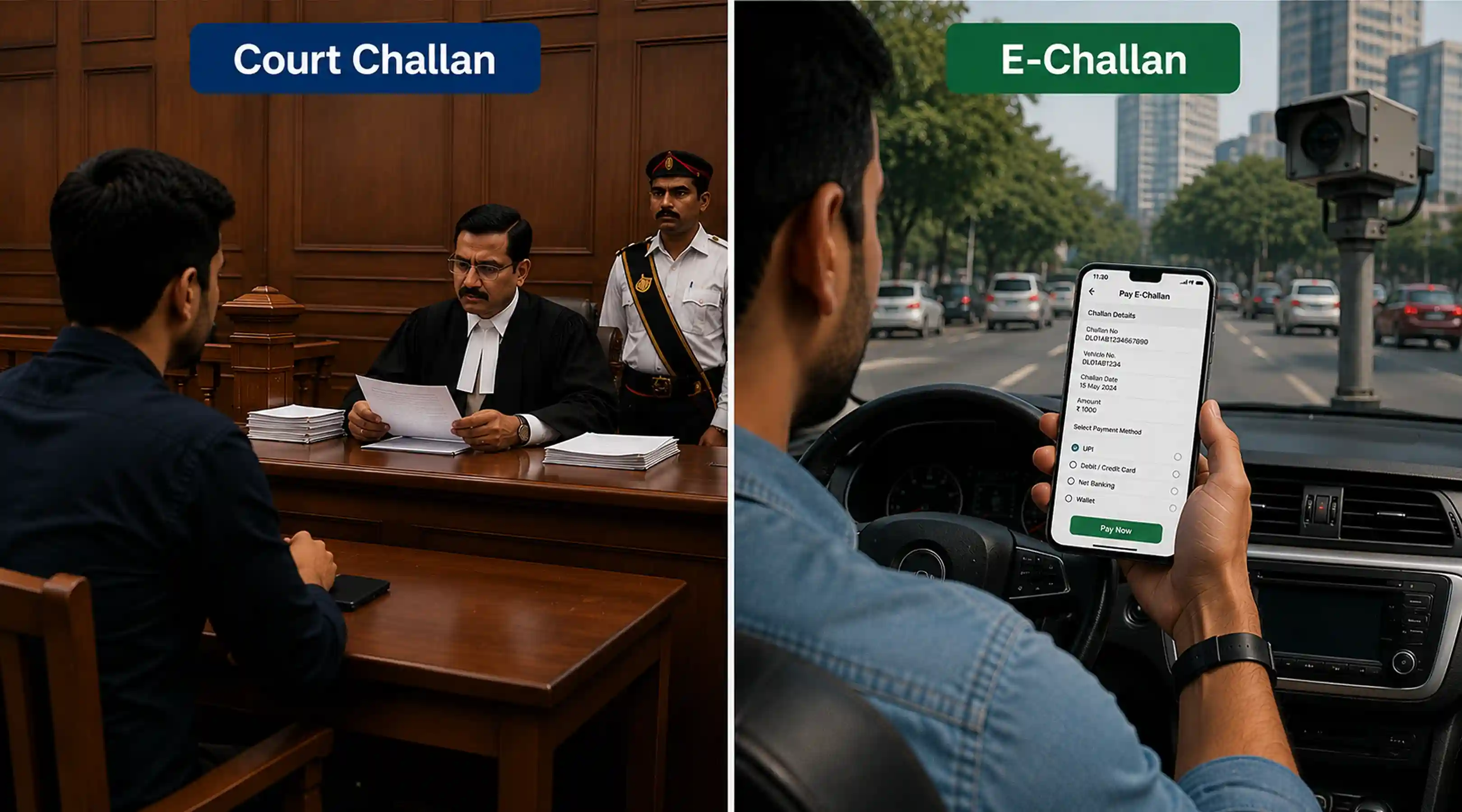
Understanding the difference between a court challan and e challan is important for every vehicle owner. Both are issued for traffic rule violations, but the payment process, legal involvement, and seriousness of the offence can differ significantly.
| Definition | Issued for serious traffic violation that may need court appearance | A digitally generated traffic challan issued through electronic devices |
|---|---|---|
| Issuing Authority | Issued by traffic police and processed through a traffic court | Issued electronically through CCTV cameras or handheld traffic devices |
| Payment Process | Payment is usually completed through court procedure | Can usually be paid online through reliable platform like Park+ |
| Resolution Time | Takes longer because of legal review | Faster process with instant online payment |
| Document Required | May require DL, RC, insurance and identity proof | Minimal documentation needed |
| Legal Consequences | May lead to licence suspension, higher penalties or legal action | Usually limited to monetary fines unless ignores repeatedly |
| Record Management | Stored in court and police legal records | Stored digitally in central databases like Parivahan |
An e-challan is a digitally generated traffic penalty issued by traffic police or automated surveillance systems. It is linked to the vehicle registration number and is usually sent through SMS.
E-challans are commonly issued for the following
It is created through traffic police devices or automated surveillance systems such as CCTV cameras and AI-based monitoring systems. Common process:
Violation Detection: Traffic authorities detect a rule violation through cameras or manual checking.
Vehicle Identification: The vehicle number is identified using ANPR technology.
Challan Generation: The traffic challan is generated digitally and linked with the vehicle details.
SMS Notification: A notification is sent to the registered mobile number of the vehicle owner.
Online Payment: Drivers can complete an online challan check and pay the fine through Parivahan or Park+.
A court challan is issued for serious traffic violations where the matter may require legal proceedings or physical verification. Instead of direct online settlement, the driver may need to appear before a traffic court or a virtual court.
Court challans are generally issued for:
In a court challan case, the driver may receive a notice directing them to appear before a traffic court or virtual court for further legal action.
Offence Detection: Traffic police identify the offence.
Challan Issuance: A court challan is issued against the driver or vehicle owner.
Court Notice: The driver receives a hearing date or legal notice from the traffic court.
Legal Review: The court examines the offence and decides the fine or legal action.
Fine Payment: The penalty amount must be paid within the timeline given by court.
Drivers can check a court challan through the official state traffic police website. The process helps users view pending notices, court dates, offence details and complete the required payment process online if applicable.
Payment steps for court challan
E-challans can usually be checked and paid online through platforms such as Park+ and Parivahan. The process is quick and helps drivers avoid additional penalties for delayed payment.
Steps to pay echallan via Park+
Step 1. Navigate to the Park+ app or website and go to the ‘E-Challan’ section.
Step 2. Enter your vehicle number and tap on ‘Check Challan’.
Step 3. View the pending challan details and choose the challan to settle.
Step 4. Click on ‘Pay Now’ to complete the payment process.
Step 5. Save or download the payment receipt for future reference.
Steps to pay challan via Parivahan
Step 1. Visit the official Parivahan eChallan portal.
Step 2. Enter your vehicle number or challan details.
Step 3. Complete the captcha verification process.
Step 4. Click on ‘Get Details’ to view pending challans.
Step 5. Select your preferred payment option and pay the fine online.
Step 6. Download the payment receipt after successful payment.
Ignoring a traffic challan can lead to serious legal and financial consequences over time. Unpaid challans may remain linked to your vehicle records and can create problems during vehicle verification, licence-related services, or future traffic checks.
In some cases, repeated non-payment may also result in stricter legal action by traffic authorities. Possible consequences include:
The difference between a court challan vs e challan mainly depends on the seriousness of the traffic violation and the legal process involved. An e-challan system is generally faster and more convenient for minor traffic violations because payments can be completed online. Court challans, however, are necessary for serious offences that require legal review.
No, some court challans can now be resolved online through virtual court platforms depending on the type of offence and state rules.
Drivers usually receive an SMS on their registered mobile number notifying about the challan along with challan details and payment information.
The payment timeline may vary by state, but drivers are generally advised to pay the e-challan within 60 days to avoid additional legal complications. In some states, it is revised to 45 days.
Yes, a regular e-challan can turn into a court challan if the fine remains unpaid for a long time or in case of repeated traffic offences.
Yes, serious traffic violations linked to court challans may affect future insurance premiums.