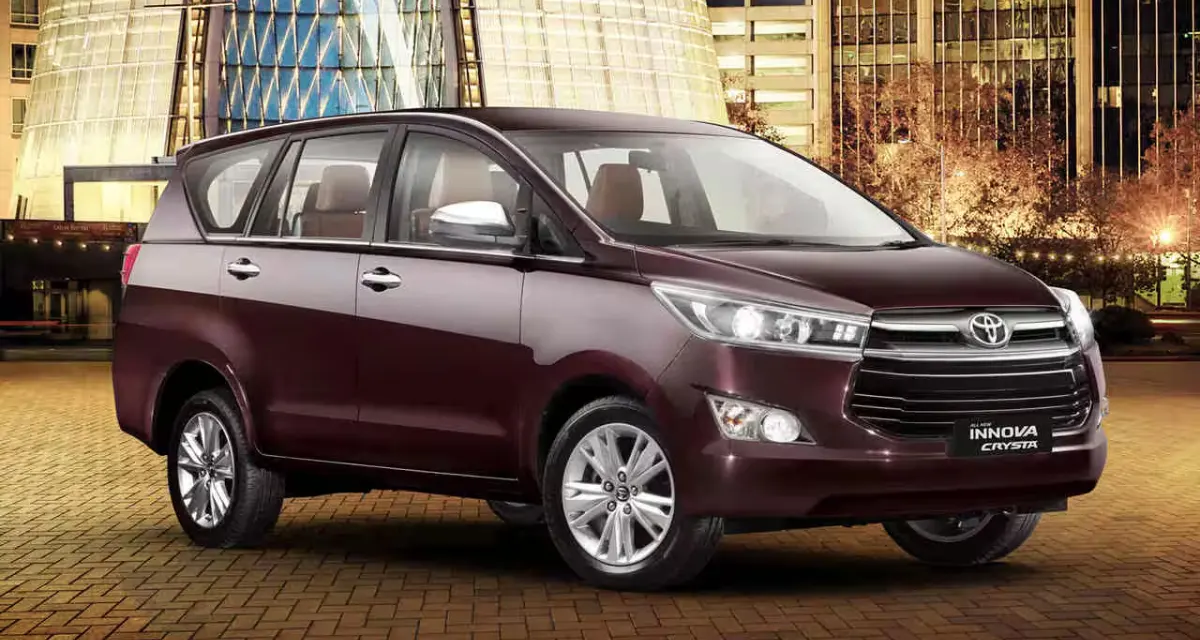
Toyota Innova Crysta to Be Discontinued in Early 2027, A Lower-Spec Innova Hycross Hybrid Set to Take Over
Why the Toyota Innova Crysta is being discontinued in early 2027?
3 emission norms play in that decision
How Toyota plans to bridge the gap with a more affordable, stripped-down version of the Innova Hycross Hybrid aimed squarely at fleet operators
The Toyota Innova Crysta has had a remarkable run. Since its launch in 2016, it became not just one of Toyota's bestsellers, but in several months, even the brand's top-selling car in India. That kind of commercial consistency, driven largely by fleet operators who prized its durability, spacious interiors, rugged build quality, low maintenance costs and strong resale value, made it a near-impossible act to follow. Yet, a new report confirms that Toyota will discontinue the Innova Crysta in early 2027.
What is particularly telling is that this was not the original plan. Toyota had intended to phase the Crysta out earlier, but persistent demand kept it alive. The situation has now changed. India's upcoming CAFE 3 norms are making it increasingly untenable to continue producing a heavy, ladder-frame diesel vehicle, and Toyota's hand has effectively been forced.
CAFE 3, or Corporate Average Fuel Economy Phase 3, will significantly tighten the emission standards that manufacturers must meet across their model range.
For a company like Toyota, continuing to sell a diesel-powered, body-on-frame MPV would work against its overall compliance position. Hybrid vehicles, by contrast, are better placed under these norms and can help manufacturers offset their fleet-level emissions more efficiently. It is this regulatory reality, rather than any weakening of consumer demand, that is driving the Crysta's exit.
Toyota is not leaving the segment without a successor. According to the report, the company is working on a more affordable, stripped-down version of the Innova Hycross Hybrid, specifically designed to appeal to fleet operators who currently rely on the Crysta.
The standard Hycross is already available with either a 171 bhp 2.0-litre petrol engine or a 181 bhp 2.0-litre petrol-hybrid, both paired with a CVT. However, the existing range presents a genuine dilemma for commercial buyers.
The base Innova Hycross petrol variant is priced at Rs 18.33 lakh, which is comparable to the Crysta's starting price of Rs 18.85 lakh. On paper, it looks like a seamless transition.
In practice, though, the petrol Hycross delivers around 10 km/l in real-world conditions, making it too expensive to run for operators covering high daily distances. The hybrid version resolves the efficiency issue, returning around 14 to 15 km/l in the real world, but it starts at Rs 26.30 lakh, which is close to Rs 7.50 lakh more than the base Crysta. That gap is simply too large for bulk fleet purchases.
The planned lower-spec hybrid variant aims to close that gap by focusing on essential features and dropping premium options to bring the price down to a more commercially viable level.
Beyond the regulatory angle, consolidating around a single monocoque platform also makes sound business sense for Toyota. Currently, maintaining both the ladder-frame Crysta and the monocoque Hycross requires operating two separate chassis lines.
Phasing out the Crysta and shifting all volume to the Hycross would streamline production and reduce per-unit costs over time, including those of the hybrid battery and motor components. There is also the possibility, though no firm indication exists yet, that hybrid vehicles could attract a lower GST rate in the future. If that were to happen, the case for the Hycross Hybrid as a fleet vehicle would strengthen considerably.
For now, the Innova Hycross is already the second bestselling Toyota in India, contributing close to 20 per cent of the brand's monthly sales. A more affordable hybrid variant, should it arrive as planned, would give that figure a significant push upwards, while honouring the legacy of one of India's most trusted MPVs.
Also read: