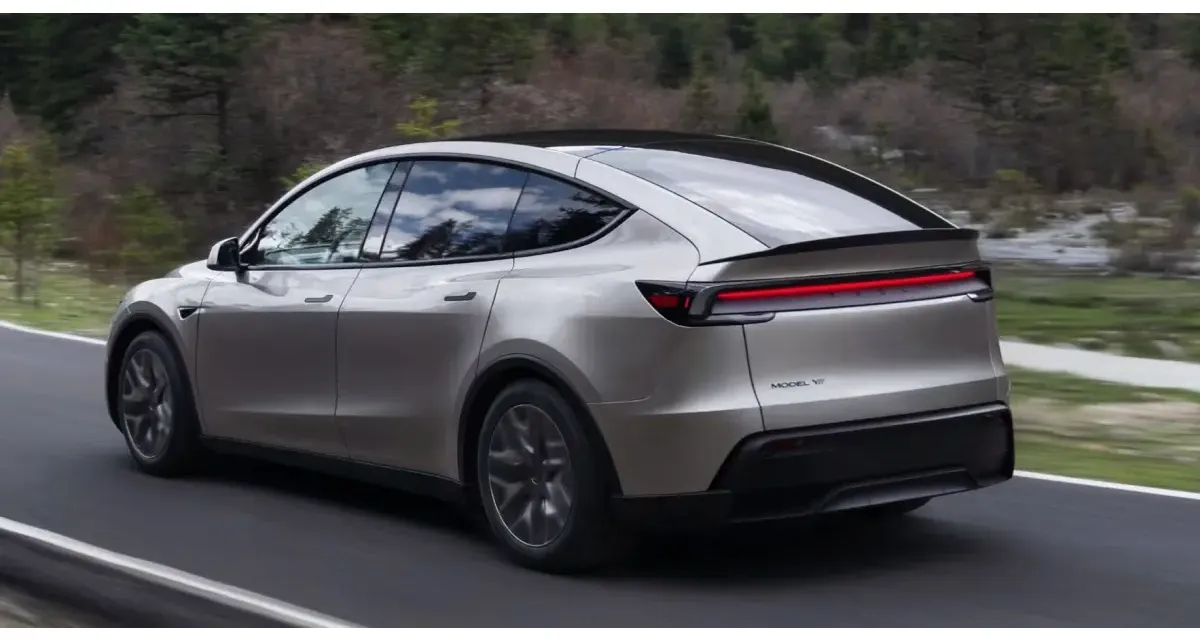
Tesla Model Y L Earns Full Five Stars in ANCAP Crash Tests
The Tesla Model Y L, a six-seat all-wheel drive electric crossover sold as a Completely Built Unit (CBU) in India, has been awarded a full five-star rating by the Australasian New Car Assessment Programme (ANCAP). The same rating extends to the standard two-row Model Y.
Both vehicles are imported from the same manufacturing facility in China, given that India and Australia share right-hand-drive configurations, making this a directly relevant result for Indian buyers.
ANCAP assessed the Model Y L across four principal categories, Adult Occupant Protection (AOP), Child Occupant Protection (COP), Vulnerable Road User Protection (VRU), and Safety Assists (SA). The results paint a detailed picture of where the car excels and where small improvements could be made.
| Category | Score | Out Of | Percentage |
|---|---|---|---|
| Adult Occupant Protection (AOP) | 36.52 | 40 | 91% |
| Child Occupant Protection (COP) | 41.40 | 49 | 84% |
| Vulnerable Road User (VRU) | 54.38 | 63 | 86% |
| Safety Assists (SA) | 16.65 | 18 | 92% |
In Adult Occupant Protection, the Model Y L achieved 36.52 out of 40, translating to 91 per cent. The frontal offset test, conducted at 50 kmph, returned an adequate rating for chest protection with good scores across all other body regions.
The full-width frontal test, also at 50 kmph, flagged adequate chest protection for both the driver and rear passenger, though all other areas again rated as good. The side impact test at 60 kmph saw the car perform flawlessly, with all critical areas rated as good.
The oblique pole test at 32 kmph returned a marginal rating for the driver's chest, the one notable weak spot in this category. Whiplash protection and far-side impact both scored full marks of 4 out of 4, with the car also performing well in the rescue and extrication assessment.
All doors remained functional post-impact, and the windows were found capable of opening for the minimum required duration in the event of the car submerging in water.
| Test | Score | Out Of | Condition |
|---|---|---|---|
| Frontal Offset | 6.40 | 8 | 50 kmph |
| Full-Width Frontal | 7.79 | 8 | 50 kmph |
| Side Impact | 6.00 | 6 | 60 kmph |
| Oblique Pole | 5.33 | 6 | 32 kmph |
| Whiplash Protection | 4.00 | 4 | — |
| Far-Side Impact | 4.00 | 4 | 60 kmph / 32 kmph |
| Rescue and Extrication | 3.00 | 4 | Post-impact |
Child Occupant Protection came in at 41.40 out of 49, which is 84 per cent. The front dynamic test at 50 kmph, using six-year-old and ten-year-old dummies, returned good scores across all critical areas.
The side dynamic test at 60 kmph told a slightly different story, with the ten-year-old dummy's chest protection rated as poor, while the six-year-old dummy continued to score well. The Child Presence Detection (CPD) system covers the second row but not the third, which meant the third row was left unassessed in this regard.
ANCAP also flagged a compatibility issue with the ISOFIX mounts, noting that the fittings on the Model Y and Model Y L do not align perfectly with the standard mounts used in Australia and New Zealand. The correct mounts would improve the rating, but the installation process is described as tricky, which accounts for the reduction in points under restraint installation, which scored 8.4 out of 12.
| Test | Score | Out Of |
|---|---|---|
| Front Dynamic Test | 16.00 | 16 |
| Side Dynamic Test | 8.00 | 8 |
| Restraint Installation | 8.40 | 12 |
| On-Board Safety Features | 9.00 | 13 |
The Vulnerable Road User category returned a score of 54.38 out of 63, or 86 per cent. Pedestrian head protection was rated as good for the bonnet and adequate for the windscreen, while the A-pillars were flagged as poor.
The Autonomous Emergency Braking (AEB) system performed particularly well, scoring full marks in pedestrian forward scenarios (7 out of 7) and cyclist detection (9 out of 9), as well as a perfect score for motorcycles (6 out of 6). The reverse AEB for pedestrians scored 1 out of 2, indicating scope for improvement in low-speed reversing situations.
It is worth noting that AEB is a mandatory feature for a five-star rating under both Euro NCAP and ANCAP protocols, which puts its performance scores under particular scrutiny. The Lane Support System (LSS) for motorcycles, operational between 1 and 150 kmph, achieved a full score of 3 out of 3.
| Test | Score | Out Of |
|---|---|---|
| Head Protection (Bonnet/Windscreen) | 13.38 | 18 |
| Pelvis Protection | 3.54 | 4.5 |
| Femur Protection | 2.60 | 4.5 |
| Knee and Tibia | 8.85 | 9 |
| AEB Pedestrian (Forward) | 7.00 | 7 |
| AEB Pedestrian (Backover) | 1.00 | 2 |
| AEB Cyclist | 9.00 | 9 |
| AEB Motorcycle | 6.00 | 6 |
| LSS Motorcycle | 3.00 | 3 |
The Model Y L's strongest performance came in the Safety Assists category, where it scored 16.65 out of 18, achieving 92 per cent.
The seatbelt reminder system scored a perfect 1 out of 1, while AEB junction and crossing, AEB head-on avoidance, and Lane Support System all returned perfect scores.
AEB car-to-car, operational between 40 and 145 kmph, scored 3.75 out of 4 with overall performance rated as good. Driver monitoring returned 1.17 out of 2, and the speed assistance system scored 2.73 out of 3.
| Test | Score | Out Of |
|---|---|---|
| Seatbelt Reminder | 1.00 | 1 |
| Driver Monitoring | 1.17 | 2 |
| Speed Assistance | 2.73 | 3 |
| AEB Car-to-Car | 3.75 | 4 |
| AEB Junction and Crossing | 4.00 | 4 |
| AEB Head-On | 1.00 | 1 |
| Lane Support System (LSS) | 3.00 | 3 |
For prospective buyers in India, the ANCAP rating carries genuine weight. The Model Y L and the standard Model Y are both sourced from the same Chinese production line as the vehicles tested, making these results directly applicable to the cars available in the Indian market.
For a vehicle positioned between a performance car and a family hauler, a five-star safety result only strengthens the case for both roles.
Also read: